
The Complete Guide to Farm-Direct Beef Cuts
A beef carcass is broken down into large sections called primals, and almost every cut you’ll see on a farm’s list comes from one of them. This guide walks through each primal, explains the cuts that come from it, and tells you how to cook them. It’s written for farm-direct buyers, so it covers the workhorse and specialty cuts a supermarket usually skips.
How to read this guide
Each section covers one primal. Inside it you’ll find a quick reference table, a temperature guide, and an entry for every cut with what it is, how it cooks, and a farm-direct note. The cuts are grouped by where they sit on the animal, not by how you’d shop for them, so a few cuts that seem similar in the kitchen (flank, skirt, and bavette, for example) live in different sections because they come from different parts of the steer.
Not every cut appears on every farm. A processor’s cut sheet decides whether the chuck becomes roasts and steaks or mostly ground beef, so two farms selling the same animal can offer very different lists. When a cut you want isn’t listed, it’s worth asking whether the farm can have it cut that way.
Chuck
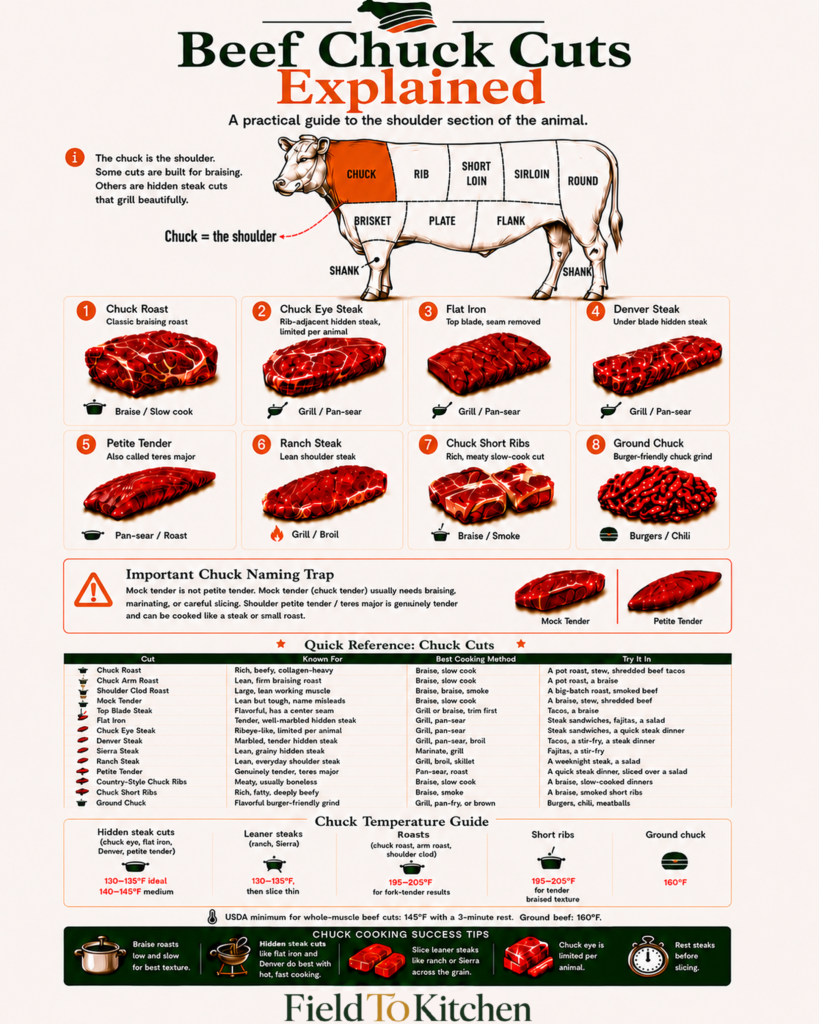
About the chuck
The chuck is the shoulder section of the animal, and it’s one of the most important primals for farm-direct beef buyers. It gives you the classic slow-cooking cuts — chuck roast, arm roast, shoulder clod, short ribs — but it also contains some surprisingly tender steaks when the butcher breaks it down carefully, including flat iron, Denver steak, chuck eye, ranch steak, and petite tender.
The key idea: chuck is not one thing. It’s a neighborhood. Some muscles work hard and need low, slow cooking. Others are hidden steak cuts that can be grilled or pan-seared. Knowing which is which saves a lot of frustration.
Chuck at a glance
| Cut | Best use | Value tier | Farm-direct note |
|---|---|---|---|
| Chuck Roast | Pot roast, shredded beef, stew, braise | Budget / Workhorse Cut | Often one of the most common roasts in a beef share |
| Chuck Eye Steak | Grilling, pan-searing | Mid-Range / Better Everyday Cut | Ribeye-like, but usually less expensive and less common per animal |
| Flat Iron | Grilling, skillet, stir-fry | Premium / Steak and Roast Cut | Great value steak when properly trimmed |
| Top Blade Steak | Braise or grill after trimming | Budget / Workhorse Cut | Can contain a tough seam if not cut into flat iron |
| Chuck Arm Roast | Pot roast, braise, pressure cooker | Budget / Workhorse Cut | Sometimes labeled arm roast, shoulder roast, or English roast |
| Mock Tender | Braise, stew, marinate | Budget / Workhorse Cut | Name is misleading — not actually tender like tenderloin |
| Shoulder Petite Tender | Grill, broil, roast whole | Premium / Steak and Roast Cut | Also called teres major — genuinely tender and rare per animal |
| Shoulder Clod Roast | Roast, braise, smoke, grind | Budget / Workhorse Cut | Large working-muscle section — often divided by the butcher |
| Denver Steak | Grill, skillet, broil | Mid-Range / Better Everyday Cut | Tender, beefy, marbled hidden steak from the under blade |
| Sierra Steak | Marinate and grill, slice thin | Mid-Range / Better Everyday Cut | Beefy but can be firmer — benefits from slicing across the grain |
| Ranch Steak | Grill, broil, skillet | Mid-Range / Better Everyday Cut | Leaner steak from shoulder clod — don’t overcook |
| Country-Style Chuck Ribs | Braise, slow cook, finish on grill | Budget / Workhorse Cut | Usually boneless and meatier than people expect |
| Chuck Short Ribs | Braise, smoke, pressure cook | Mid-Range / Better Everyday Cut | Rich, meaty, excellent slow-cooking cut |
| Ground Chuck | Versatile — cooking method follows the dish (grill for burgers, simmer for chili, bake for meatloaf) | Budget / Workhorse Cut | One of the most flavorful ground beef options — chuck’s fat ratio makes it the standard for burgers |
Chuck temperature guide
The temperatures below separate culinary doneness targets from USDA food-safety minimums. For whole-muscle beef cuts, USDA guidance is 145°F with a 3-minute rest. Many steak doneness targets are lower and reflect common culinary preference rather than USDA minimum guidance. Ground beef should always be cooked to 160°F as measured with a thermometer.
| Use case | Best target | USDA minimum |
|---|---|---|
| Chuck eye, Denver, flat iron, petite tender | 130 to 135°F (medium-rare) to 140 to 145°F (medium) | 145°F with 3-minute rest |
| Ranch steak, Sierra steak | 130 to 135°F, sliced thin | 145°F with 3-minute rest |
| Chuck roast, arm roast, shoulder clod | Cook until fork-tender (195 to 205°F internal) | 145°F minimum, but tenderness requires much higher |
| Chuck short ribs, country-style chuck ribs | Cook until tender enough to pull or slice cleanly (195 to 205°F) | 145°F minimum |
| Ground chuck | 160°F as measured with a thermometer — color is not a reliable indicator | 160°F |
Important note on slow-cooking cuts: For chuck roast, short ribs, and similar cuts, the USDA food safety minimum of 145°F is not the eating target. These cuts need to reach 195 to 205°F before the collagen and connective tissue soften into the texture you’re looking for. Food safety and eating quality point to very different temperatures here.
Not all “tender” names mean the same thing. Mock tender (also called chuck tender) sounds like tenderloin, but it isn’t especially tender and usually needs braising, marinating, or careful slicing. Shoulder petite tender, also called teres major, is a completely different cut and really can be cooked like a small tender steak or roast. Don’t confuse them.
Chuck Roast
May be labeled or grouped as: blade roast, 7-bone roast, shoulder roast, English roast, cross rib roast, or shoulder pot roast depending on processor and region. Note: arm roast is listed separately in this guide as it comes from a slightly different part of the shoulder.
What it is: Chuck roast comes from the shoulder and is one of the most flavorful braising cuts on the animal. It has deep beef flavor and connective tissue throughout, which is exactly what makes it great for slow cooking — that connective tissue melts into the cooking liquid and creates rich, silky results.
Flavor and texture: Bold, beefy, and well-marbled. Raw, it can feel firm and look well-worked. Cooked correctly, it becomes fall-apart tender with a rich, savory depth that leaner cuts can’t match.
Best cooking methods:
- Braising (pot roast, red wine braise, short rib-style)
- Slow cooker or pressure cooker
- Smoking low and slow
- Shredded beef for tacos, Italian beef, birria, or sandwiches
How to cook: Salt well ahead of time, sear hard on all sides for a good crust, then cook covered with a small amount of liquid at low heat until it pulls apart easily. Don’t stop just because it hit 145°F. Chuck roast is done when it’s fork-tender, not when it hits a minimum internal temperature.
Temperatures:
- Food safety minimum: 145°F with 3-minute rest
- Eating target for pot roast or shredded beef: 195 to 205°F internal, where collagen fully breaks down
- Typical cook time: 3 to 4 hours braised, 8 to 10 hours in a slow cooker on low, 60 to 90 minutes in a pressure cooker
Value tier: Budget / Workhorse Cut. Chuck roast is one of the best value cuts on the animal.
Farm-direct note: Chuck roast is often one of the most common roasts in a beef share. Depending on your processor, you might see it labeled any of the names listed above. If your cut sheet just says “roasts,” chuck roast is likely part of that bucket.
Worth knowing: Don’t dry-roast it like prime rib. It needs moisture or very low heat over a long time. The fat and connective tissue are there for a reason.
Chuck Eye Steak
Also called: chuck delmonico, poor man’s ribeye
What it is: Chuck eye steak comes from the rib end of the chuck eye roll, right where the rib primal begins. It’s often described as a lower-cost alternative to ribeye because it comes from adjacent muscles with similar marbling and flavor.
Flavor and texture: Rich, beefy, and well-marbled. Tender enough to grill without braising, though it’s less consistently uniform than ribeye. Some chuck eyes have a small seam of connective tissue, others don’t.
Best cooking methods:
- Grilling over high heat
- Cast iron pan-searing
- Broiling
- Steak sandwiches
How to cook: Treat it like a steak. Salt, bring to room temperature, sear hard, rest, and slice. Medium-rare to medium is the sweet spot.
Temperatures:
- Rare: 120 to 125°F
- Medium-rare: 130 to 135°F (recommended)
- Medium: 140 to 145°F
- USDA minimum: 145°F with 3-minute rest
Value tier: Mid-Range / Better Everyday Cut. Less expensive than ribeye with similar eating quality when cooked correctly.
Farm-direct note: There are only a few chuck eye steaks per animal, so you may not always get them in a share unless the cut sheet asks for them specifically. Some butchers use this section for roast or grind by default.
Worth knowing: Don’t confuse chuck eye steak with generic “chuck steak,” which can be tougher and may need marinating or braising. Chuck eye is the specific rib-adjacent portion — the tender one.
Chuck Eye Roll
What it is: The chuck eye roll is a larger butcher’s section rather than a single consumer cut. It’s the muscle group that runs through the center of the chuck, adjacent to the rib, and it’s the source of chuck eye steaks, Denver steaks, and other chuck steak cuts.
Farm-direct note: Most buyers won’t see “chuck eye roll” on a freezer label. It matters because it explains why different farms and processors produce different chuck cuts from the same primal. A processor doing detailed seam butchery will break it into chuck eye steaks, Denver steaks, and other cuts. A simpler breakdown might turn the same section into roast, stew meat, or ground beef.
How to use this information: Think of the chuck eye roll as the neighborhood — chuck eye steak, Denver steak, and similar cuts are the addresses within it. If your share includes those cuts, the processor is doing more detailed work. If it doesn’t, the same meat likely went somewhere else.
Flat Iron Steak
Related cut: Top blade steak. Flat iron comes from the same general area, but the tough internal seam has been removed through seam butchery — which is what makes it a grillable steak. Without that step, the same section is top blade steak. Also called butler’s steak in the UK.
What it is: Flat iron is one of the best examples of modern butchery making the chuck more useful. It comes from the top blade, and when the internal line of connective tissue is removed through seam butchery, what remains is a tender, well-marbled steak. Without that removal, the same section becomes top blade steak, which is less easy to cook.
Flavor and texture: Strong beef flavor, good marbling, and surprisingly tender for a chuck cut. Slightly firmer than ribeye but more flavorful than many leaner steak cuts.
Best cooking methods:
- Grilling over high heat
- Cast iron pan-searing
- Stir-fry (sliced thin)
- Steak salad
- Tacos or fajitas
How to cook: High heat, rest well, and always slice across the grain. It’s excellent for steak salads because the beef flavor holds up to vinaigrettes and greens.
Temperatures:
- Rare: 120 to 125°F
- Medium-rare: 130 to 135°F (recommended — this is where it shines)
- Medium: 140 to 145°F
- Avoid well-done: the steak loses its appeal past medium
- USDA minimum: 145°F with 3-minute rest
Value tier: Premium / Steak and Roast Cut. When properly butchered, flat iron is a legitimately premium grilling steak — tender, well-marbled, and priced closer to ribeye and NY strip than to budget chuck cuts. Prices vary by farm and region.
Farm-direct note: If your farm offers flat iron steaks, that’s a sign the processor is doing more detailed seam butchery. In a more basic beef share, the same area might become top blade steak, chuck roast, stew meat, or grind. Worth requesting specifically if you want it.
Worth knowing: Flat iron and top blade steak come from the same muscle area, but they aren’t the same eating experience. The difference is whether the connective tissue seam has been removed. Always slice across the grain.
Top Blade Steak
What it is: Top blade steak comes from the same general area as flat iron but still has the internal seam of connective tissue running through it. This is the same muscle, less precisely butchered.
Flavor and texture: Good beef flavor and marbling, but the connective tissue line through the middle requires some navigation when eating or cooking.
Best cooking methods:
- Braising (the connective tissue softens with low, slow heat)
- Marinating and grilling if well-trimmed
- Cutting around the seam and using the trimmed pieces for stir-fry or steak bites
Temperatures:
- If grilling: medium-rare to medium (130 to 145°F) and slice across the grain
- If braising: cook until the connective tissue softens, 190 to 200°F or until tender
- USDA minimum: 145°F with 3-minute rest
Value tier: Budget / Workhorse Cut. Less expensive than flat iron because of the seam.
Farm-direct note: If your share includes top blade steak rather than flat iron, the difference is in how the butcher broke down the primal. Both are useful — just cook them accordingly.
Worth knowing: Don’t assume top blade steak cooks exactly like flat iron. The seam is the variable. Braise it, trim it, or cut around it.
Chuck Arm Roast
Also called: arm roast, shoulder roast, English roast, cross rib roast (labeling varies widely)
What it is: Chuck arm roast is an economical, flavorful shoulder roast from the arm section of the chuck. It has good marbling and connective tissue that rewards slow cooking.
Flavor and texture: Deep beef flavor with a slightly leaner profile than blade chuck roast. Still benefits from long, moist cooking.
Best cooking methods:
- Braising with stock, wine, or tomato base
- Slow cooker
- Pressure cooker
- Pot roast style
How to cook: Braise with stock, wine, tomato, onions, garlic, and herbs. Cook until fork-tender, not just until it hits a minimum temperature.
Temperatures:
- Food safety minimum: 145°F with 3-minute rest
- Eating target: 195 to 205°F for fork-tender results
- Typical cook time: 3 to 4 hours braised, 8 hours in a slow cooker on low
Value tier: Budget / Workhorse Cut. One of the more economical shoulder cuts.
Farm-direct note: This cut appears under many names depending on the processor. If you’re not sure what you have, check whether it looks like a roast rather than a steak — then braise it.
Worth knowing: Don’t dry-roast it like prime rib. It needs moisture or very low heat over time. Avoid treating it as a quick-cook cut.
Mock Tender / Chuck Tender
Also called: chuck tender, scotch tender. Sometimes labeled shoulder tender — not to be confused with shoulder petite tender / teres major, which is a completely different and genuinely tender cut.
What it is: Mock tender is a lean, torpedo-shaped cut from the chuck that resembles tenderloin in shape. The name is the trap: it is not tender like tenderloin, and treating it that way leads to a tough, disappointing result.
Flavor and texture: Lean, firm, and flavorful when cooked properly. Braised or stewed, it becomes more approachable. Grilled without preparation, it can be chewy.
Best cooking methods:
- Braising
- Slow cooker
- Marinating before grilling (slice thin across the grain)
- Stew meat
How to cook: Braise it, slow cook it, or marinate deeply and slice thin after grilling. Don’t cook it like a tenderloin.
Temperatures:
- If braising: cook to 190 to 200°F or until tender
- If grilling: no more than medium (140 to 145°F), then slice thin across the grain
- USDA minimum: 145°F with 3-minute rest
Value tier: Budget / Workhorse Cut. Inexpensive because it requires more effort to cook well.
Farm-direct note: If you see this in your share, plan for braising. It’s a genuinely useful cut when treated correctly.
Callout: Mock tender is not petite tender. They’re different muscles with different cooking requirements. See the Shoulder Petite Tender entry below.
Shoulder Petite Tender / Teres Major
Also called: teres major, petite tender medallions, shoulder tender
What it is: Shoulder petite tender, also called teres major, is a small, genuinely tender muscle from the shoulder clod. It’s one of the hidden gems of the chuck, often compared to tenderloin in texture despite coming from the shoulder. There is only one per side of beef, which keeps it relatively rare.
Flavor and texture: Tender, juicy, and flavorful with good beef character. Similar eating experience to filet mignon, but with a bit more beefy flavor and a smaller size.
Best cooking methods:
- Grilling whole
- Broiling
- Pan-searing and roasting
- Sliced into medallions and seared
How to cook: Salt, sear hard all around, and finish gently if needed. Rest before slicing. Works beautifully with chimichurri, pan sauce, compound butter, or a simple herb rub.
Temperatures:
- Rare: 120 to 125°F
- Medium-rare: 130 to 135°F (recommended)
- Medium: 140 to 145°F
- USDA minimum: 145°F with 3-minute rest
Value tier: Premium / Steak and Roast Cut. Limited quantity per animal and genuinely tender — one of the most underappreciated cuts in the chuck.
Farm-direct note: If a farm lists petite tender or teres major, it’s a sign the butcher is doing careful, detailed work. This is a great cut for farms to highlight and a reason to ask for it specifically on a cut sheet if available.
Worth knowing: This is one of the biggest naming confusions in the chuck section. Mock tender and petite tender are completely different cuts with completely different cooking requirements. See the callout above.
Shoulder Clod Roast
What it is: The shoulder clod is a large section of the chuck made up of multiple muscles. It can be left whole, broken into roasts, cut into steaks like ranch steak, or used for stew meat and grind. It’s a working muscle group that rewards slow cooking when kept as a roast.
Flavor and texture: Rich beef flavor, firm texture. When slow-cooked, it becomes tender and flavorful. Steaks cut from it vary in tenderness depending on the specific muscle.
Best cooking methods:
- Braising
- Smoking low and slow
- Slow roasting
- Breaking down into ranch steak, stew meat, or ground beef
How to cook: If whole or roast-sized, cook low and slow with moisture. If cut into steaks, pay attention to grain direction and don’t overcook.
Temperatures:
- As a roast: 195 to 205°F internal for fork-tender results
- As steaks: medium-rare to medium (130 to 145°F)
- USDA minimum: 145°F with 3-minute rest
Value tier: Budget / Workhorse Cut. One of the more economical large roast cuts.
Farm-direct note: Most home buyers won’t see a whole shoulder clod labeled as such. But they may see the results of it: ranch steak, arm roast, shoulder roast, stew meat, or ground beef. It’s one of those cuts that disappears into other labels.
Denver Steak
What it is: Denver steak is a relatively newer butcher’s cut from the center of the under blade muscle in the chuck. It’s known for marbling, tenderness, and strong beef flavor — and it’s one of the best examples of skilled butchery unlocking value from the chuck.
Flavor and texture: Well-marbled, tender for a chuck cut, and intensely beefy. Often compared favorably to ribeye in flavor, with slightly more chew.
Best cooking methods:
- Grilling over high heat
- Cast iron pan-searing
- Broiling
- Steak tacos or rice bowls
How to cook: High heat, medium-rare to medium, rest well, and always slice across the grain. Excellent for people who want ribeye flavor at a more accessible price.
Temperatures:
- Rare: 120 to 125°F
- Medium-rare: 130 to 135°F (recommended)
- Medium: 140 to 145°F
- USDA minimum: 145°F with 3-minute rest
Value tier: Mid-Range / Better Everyday Cut. Strong value for the eating quality — typically less expensive than flat iron or ribeye but noticeably more than roasting and grinding cuts. Prices vary by farm and region.
Farm-direct note: If a farm lists Denver steak, that’s a sign the butcher is doing more detailed breakdown work. In many shares, this same area becomes roast, stew meat, or ground beef. Worth requesting specifically on a cut sheet if available.
Worth knowing: Denver is a steak, not a pot roast cut. Don’t default to slow-cooking it just because it comes from the chuck.
Sierra Steak
What it is: Sierra steak is a chuck steak, usually from the under blade or shoulder area. It has strong beef flavor but can be firmer than flat iron or Denver, so it benefits from marinade, high heat, and careful slicing.
Flavor and texture: Bold, beefy flavor with a firmer texture than premium steak cuts. Benefits significantly from a marinade or dry brine.
Best cooking methods:
- Marinating, then grilling
- Pan-searing
- Slicing thin across the grain for steak tacos or sandwiches
How to cook: Marinate or dry-brine for several hours, cook hot and fast, rest, and slice thin across the grain. Works well in preparations where the beef is the supporting flavor rather than the centerpiece.
Temperatures:
- Medium-rare: 130 to 135°F, then slice thin
- Medium: 140 to 145°F maximum before slicing
- USDA minimum: 145°F with 3-minute rest
Value tier: Mid-Range / Better Everyday Cut. Often appears on farms trying to offer more steak variety beyond the usual lineup.
Farm-direct note: Sierra steak is one of those cuts that may appear when a farm or processor is trying to maximize steak yield from the chuck. Useful, but it needs cooking guidance to get the best result.
Worth knowing: Don’t serve it as a thick steak without slicing guidance. The grain direction matters here more than with more tender cuts.
Ranch Steak
Also called: shoulder center steak, boneless chuck shoulder center cut steak
What it is: Ranch steak is a lean chuck steak cut across the grain from the shoulder clod. It’s an affordable, versatile weeknight cut that rewards quick cooking and thin slicing.
Flavor and texture: Lean, firm, and flavorful. Less marbling than Denver or flat iron, so the cooking window is smaller — it dries out quickly past medium.
Best cooking methods:
- Grilling
- Broiling
- Skillet cooking
- Steak salads, fajita-style plates, rice bowls
How to cook: Marinate or dry-brine, cook quickly over high heat, and slice thin across the grain. Don’t push it past medium unless you’re slicing it thin into a saucy dish.
Temperatures:
- Medium-rare: 130 to 135°F (recommended for best texture)
- Medium: 140 to 145°F maximum
- USDA minimum: 145°F with 3-minute rest
Value tier: Mid-Range / Better Everyday Cut. Lean and affordable, but it’s a steak cut — not a braising or grinding cut. Pricing sits below Denver and flat iron but above workhorse roasting cuts.
Farm-direct note: Ranch steak is a good weeknight steak, not a ribeye substitute. It’s leaner, so the cooking window is narrower. Treat it accordingly.
Worth knowing: Visible connective tissue should be removed before cooking. If your ranch steak has a tough outer seam, trim it before it hits the pan or grill.
Country-Style Chuck Ribs
What it is: Country-style chuck ribs are usually meaty, boneless strips from the chuck. Despite the name, they may not always look like traditional ribs — think of them as rich, beefy braising strips rather than the rack-style ribs most people picture.
Flavor and texture: Rich, beefy, and well-marbled. Deeply flavorful when slow-cooked. The “ribs” label can confuse people into grilling them too quickly, which doesn’t serve them well.
Best cooking methods:
- Slow cooker
- Braising
- Pressure cooker
- Braise, then glaze and finish on the grill
How to cook: Braise until very tender, then glaze and finish under the broiler or on the grill for color and caramelization. The braise-then-grill approach gives you both tenderness and a satisfying exterior.
Temperatures:
- Cooking target: 195 to 205°F internal for tender, pull-apart results
- USDA minimum: 145°F with 3-minute rest (but this is not the eating target)
- Typical cook time: 2 to 3 hours braised, 6 to 8 hours in a slow cooker on low
Value tier: Budget / Workhorse Cut. Excellent value for how satisfying they are when cooked properly.
Farm-direct note: These may appear in your share as country-style ribs or chuck ribs. Don’t confuse them with back ribs or plate short ribs — the cooking approach is similar, but the cut is different.
Worth knowing: They’re called ribs, but they may be boneless. The name refers to the style and section, not always the structure of the cut.
Chuck Short Ribs
Also called: English-cut short ribs, flanken-cut short ribs (depends on how they’re cut)
What it is: Chuck short ribs are rich, meaty ribs from the chuck section, known for excellent slow-cooking results. The cut style matters significantly: English-cut ribs are thick individual ribs cut parallel to the bone, while flanken-cut ribs are thin strips cut across multiple bones.
Flavor and texture: Rich, beefy, well-marbled, and deeply satisfying when braised. One of the most rewarding slow-cooking cuts on the animal.
Best cooking methods:
- Braising (classic red wine or Korean-style galbi)
- Smoking low and slow
- Pressure cooking
- For flanken-cut: marinate and grill hot and fast
How to cook: For thick English-style: braise or smoke low and slow until the meat pulls away from the bone cleanly. For thin flanken-style: marinate in a soy-based sauce and grill quickly over high heat.
Temperatures:
- Cooking target: 195 to 205°F for braised English-cut ribs
- Flanken-cut grilled: medium (140 to 145°F), served immediately
- USDA minimum: 145°F with 3-minute rest
- Typical braise time: 3 to 4 hours at 325°F
Value tier: Mid-Range / Better Everyday Cut. More expensive than roasting cuts but worth it for the eating quality.
Farm-direct note: If your share includes short ribs, ask whether they’re English-cut or flanken-cut. The same name covers two very different preparations. Also worth knowing: “short ribs” can refer to plate short ribs or chuck short ribs — they cook similarly but come from different sections.
Worth knowing: One short rib recipe doesn’t work for every short rib cut. Thickness and cut style change everything about how you should cook them.
Ground Chuck
What it is: Ground chuck is ground beef made from the chuck section, typically with a fat ratio around 80/20 (80% lean, 20% fat). In a beef share, some chuck ends up as ground beef because not every shoulder muscle makes sense as a steak or roast. This is not a downgrade — ground from a flavorful primal like chuck is often where farm-direct beef shines most clearly.
Flavor and texture: Rich, beefy, and juicy. The fat ratio keeps it moist and flavorful through cooking, which is why chuck is considered the gold standard fat ratio for burgers.
Best cooking methods — depends on what you’re making:
- Burgers: Grill or cast iron pan-sear over high heat. Handle the meat as little as possible and don’t press the patties down while cooking.
- Meatballs and meatloaf: Oven-baked. The fat content helps with moisture throughout.
- Chili, Bolognese, or cottage pie: Brown in a skillet or Dutch oven first, then simmer or pressure cook.
- Tacos: Brown in a skillet, break up as it cooks, season well.
- Slow cooker or pressure cooker dishes: Works well when left in larger pieces or crumbled into a braise.
The right cooking method follows the dish, not the cut. Ground chuck is one of the most versatile things in your freezer precisely because it adapts to almost anything.
Temperatures:
- USDA minimum for ground beef: 160°F as measured with a thermometer
- Color is not a reliable indicator — ground beef can turn brown before reaching a safe temperature, and can also remain pink above 160°F
- Always use a thermometer; don’t rely on visual cues
Value tier: Budget / Workhorse Cut. Ground beef is one of the most economical items in any beef share.
Farm-direct note: Farm-direct ground beef is often noticeably more flavorful than supermarket ground beef. It’s not just filler — it’s where trimmings from the most flavorful sections of the animal come together. It’s also one of the cuts that will make up a significant portion of your share, especially in a quarter or half cow.
Worth knowing: Ground beef fat ratios matter. 80/20 (ground chuck) is the standard for burgers. 85/15 is leaner and works well for meatballs or dishes with added fat. 90/10 or leaner can dry out in a burger without added fat or binders.
Rib
About the rib
The rib is one of the most familiar and prized sections of the animal. If the chuck is where farm-direct buyers learn the difference between workhorse cuts and hidden steaks, the rib is where most people already know the headline names: ribeye, prime rib, cowboy steak, and back ribs.
This section sits between the chuck and the short loin. It does less work than the shoulder, which is why the major rib cuts are naturally tender, richly marbled, and well suited to dry-heat cooking methods like grilling, roasting, broiling, and pan-searing.
The key idea: rib cuts are usually premium cuts, but they’re not all the same thing. A boneless ribeye steak, bone-in rib steak, standing rib roast, and beef back ribs may all come from the same general primal, but they cook differently, portion differently, and show up differently in a farm-direct beef share.
Rib at a glance
| Cut | Best use | Value tier | Farm-direct note |
|---|---|---|---|
| Ribeye Steak | Grilling, cast iron, broiling | Premium / Steak and Roast Cut | One of the most recognizable premium steaks in a beef share |
| Bone-In Ribeye / Cowboy Steak | Grilling, reverse sear, special occasion | Premium / Steak and Roast Cut | Same ribeye family, but with the bone left on for presentation and flavor |
| Rib Steak | Grilling, pan-searing, broiling | Premium / Steak and Roast Cut | Often used interchangeably with bone-in ribeye depending on processor |
| Prime Rib / Standing Rib Roast | Holiday roast, centerpiece meal | Premium / Steak and Roast Cut | Usually bone-in and roasted whole or in a multi-bone section |
| Boneless Rib Roast / Ribeye Roast | Roasting, slicing for roast beef, portioning into steaks | Premium / Steak and Roast Cut | Can be cooked whole or cut into ribeye steaks |
| Back Ribs | Smoking, braising, slow roasting | Mid-Range / Better Everyday Cut | Often less meaty than short ribs, but flavorful when cooked properly |
| Short Ribs (from the rib section) | Braising, smoking, pressure cooking | Mid-Range / Better Everyday Cut | May be labeled simply as short ribs or beef short ribs depending on processor |
| Ribeye Cap / Spinalis | Hot-and-fast searing | Specialty / Rare or Unique Cut | Rarely sold separately, but worth knowing because it’s the most prized part of a ribeye |
Rib temperature guide
The temperatures below separate culinary doneness targets from USDA food-safety minimums. For whole-muscle beef cuts, USDA guidance is 145°F with a 3-minute rest. Many steak and roast doneness targets are lower and reflect common culinary preference rather than USDA minimum guidance.
| Use case | Best target | USDA minimum |
|---|---|---|
| Ribeye steak, bone-in ribeye, rib steak | 130 to 135°F (medium-rare) to 140 to 145°F (medium) | 145°F with 3-minute rest |
| Prime rib / standing rib roast | Pull below your desired final serving temp; carryover cooking is significant on large roasts | 145°F with 3-minute rest |
| Boneless rib roast / ribeye roast | 125 to 135°F depending on preference for rare to medium-rare | 145°F with 3-minute rest |
| Back ribs | Cook until tender, often 195 to 205°F | 145°F minimum, but tenderness requires higher |
| Short ribs from the rib section | Cook until tender enough to pull or slice cleanly, often 195 to 205°F | 145°F minimum, but tenderness requires higher |
Important note on rib cuts: Ribeye steaks and rib roasts are naturally tender and taste best cooked to steak or roast doneness targets. Back ribs and rib short ribs are different. They need low, slow cooking because the goal isn’t just food safety. It’s softening connective tissue and building tenderness over time.
Ribeye, rib steak, rib roast, and prime rib are related but not identical. A ribeye steak is a steak cut from the rib section. A bone-in ribeye or rib steak keeps the bone attached. A rib roast is the larger roast version of the same neighborhood. Prime rib usually refers to a standing rib roast preparation, often served as a holiday or special-occasion roast. The names overlap, but the cooking method depends on whether you have a steak, a roast, or ribs.
Back ribs are not short ribs. Back ribs come from the upper rib section after the ribeye or rib roast is removed, which is why they can be less meaty. Short ribs can come from the chuck, plate, or lower rib area depending on how the animal is broken down, and they are usually meatier, richer, and better suited to braising or smoking. If your beef back ribs look bony and lean, that’s normal. If you want meaty ribs for braising, plate short ribs or chuck short ribs are usually the better choice.
Ribeye Steak
Also called: boneless ribeye, rib eye steak
What it is: Ribeye steak is one of the classic premium beef cuts. It comes from the rib section and is prized for its marbling, tenderness, and rich beef flavor. Compared with leaner steaks, ribeye has more internal fat, which helps it stay juicy and flavorful over high heat.
Flavor and texture: Rich, buttery, juicy, and tender. Ribeye has a looser, more marbled texture than strip steak and a deeper fat-driven flavor than leaner cuts like sirloin or tenderloin.
Best cooking methods:
- Grilling over high heat
- Cast iron pan-searing
- Reverse sear for thicker steaks
- Broiling
- Skillet-to-oven for thick cuts
How to cook: Salt ahead if possible and let the steak sit while the pan or grill preheats. Sear hard over high heat. For thick ribeyes, use a two-stage method: cook gently first, then sear hard at the end. Rest before slicing so the juices redistribute.
Temperatures:
- Rare: 120 to 125°F
- Medium-rare: 130 to 135°F (recommended)
- Medium: 140 to 145°F
- USDA minimum: 145°F with 3-minute rest
Value tier: Premium / Steak and Roast Cut. Ribeye is one of the most valuable and recognizable steaks on the animal.
Farm-direct note: In a beef share, ribeyes are limited. Depending on your cut sheet, the rib section may be cut into boneless ribeye steaks, bone-in rib steaks, or left as a rib roast. You usually can’t maximize all of those from the same section, so the cut sheet choice matters.
Worth knowing: Ribeye is forgiving because of its marbling, but that doesn’t mean it should be cooked carelessly. It can handle more heat than lean steaks, but overcooking still dulls what makes the cut special.
Bone-In Ribeye / Cowboy Steak
Also called: bone-in ribeye, cowboy ribeye, cowboy steak, rib steak, tomahawk steak (when the bone is left extra long and frenched)
What it is: Bone-in ribeye is a ribeye steak with the rib bone left attached. When cut thick with a dramatic bone, it’s often marketed as a cowboy steak. If the bone is left extra long and frenched, it may be called a tomahawk steak. The eating quality is the same ribeye muscle regardless of bone length.
Flavor and texture: Rich, marbled, tender, and dramatic. The eating quality is very similar to boneless ribeye, with the added appeal of bone-in presentation and the meat close to the bone.
Best cooking methods:
- Grilling
- Reverse sear
- Cast iron plus oven finish
- Broiling for thinner cuts
How to cook: Because bone-in ribeyes are often thicker than boneless steaks, they benefit from a reverse sear or two-zone grilling. Bring the steak up gently over indirect heat, then finish with a hard sear. Rest well before slicing.
Temperatures:
- Rare: 120 to 125°F
- Medium-rare: 130 to 135°F (recommended)
- Medium: 140 to 145°F
- USDA minimum: 145°F with 3-minute rest
Value tier: Premium / Steak and Roast Cut. This is usually one of the highest-value steak cuts in a farm’s lineup.
Farm-direct note: Some farms may list this as bone-in ribeye, cowboy steak, or rib steak. The exact label depends on thickness, bone length, and processor preference.
Worth knowing: The bone makes the steak look bigger and more impressive, but thickness matters more than the bone when choosing a cooking method. A thick cowboy steak shouldn’t be cooked the same way as a thin supermarket steak.
Rib Steak
Also called: bone-in rib steak, bone-in ribeye
What it is: Rib steak is usually the simpler farm or processor label for a bone-in ribeye-style steak. It may not look as dramatic as a cowboy steak or tomahawk, but it belongs to the same ribeye family and eats the same way. If your freezer package says “rib steak,” don’t assume it’s a different eating category from ribeye.
Flavor and texture: Rich, beefy, tender, and well-marbled. Very similar eating experience to bone-in ribeye.
Best cooking methods:
- Grilling
- Cast iron pan-searing
- Broiling
- Skillet-to-oven for thicker cuts
How to cook: Cook hot and fast for thinner cuts, or use a reverse sear for thick-cut rib steaks. Salt ahead, sear thoroughly, rest, and slice.
Temperatures:
- Rare: 120 to 125°F
- Medium-rare: 130 to 135°F (recommended)
- Medium: 140 to 145°F
- USDA minimum: 145°F with 3-minute rest
Value tier: Premium / Steak and Roast Cut. Rib steak belongs in the same premium family as ribeye.
Farm-direct note: If your beef share says “rib steak,” don’t assume it’s a different eating category from ribeye. It may simply mean the bone was left in or the processor uses older-style labeling.
Worth knowing: Rib steak is a good example of why farm-direct naming can be confusing. The same general section may be labeled ribeye, bone-in ribeye, rib steak, cowboy steak, or rib roast depending on how it was cut.
Prime Rib / Standing Rib Roast
Also called: standing rib roast, bone-in rib roast, prime rib roast
What it is: Prime rib usually refers to a rib roast cooked as a centerpiece roast, often bone-in. “Standing” means the roast can stand on the rib bones while roasting. Despite the name, “prime rib” doesn’t always mean the beef is USDA Prime grade. It usually refers to the cut and the preparation style.
Flavor and texture: Rich, tender, juicy, and luxurious. Prime rib has the flavor of ribeye in roast form, with a dramatic presentation and a mix of tender center slices, browned exterior, and fatty edges.
Best cooking methods:
- Low-and-slow oven roasting
- Reverse sear
- Traditional high-heat-then-rest approach
- Smoking followed by a hot finish
How to cook: Salt the roast well ahead of time. Roast gently until the center is a few degrees below your final serving temperature, then rest thoroughly. Carryover cooking is significant in large roasts, so pull temperature matters. For a browned crust, use high heat at the beginning or the end of the cook.
Temperatures:
- Rare final serving temp: 120 to 125°F (pull around 115°F)
- Medium-rare final serving temp: 130 to 135°F (pull around 125 to 128°F)
- Medium final serving temp: 140 to 145°F (pull around 135°F)
- USDA minimum: 145°F with 3-minute rest
- Pull temperatures are estimates. Large roasts carry over more or less depending on size, oven temperature, and rest time. Use a thermometer and check early rather than relying on a single pull temp.
Value tier: Premium / Steak and Roast Cut. This is one of the most special-occasion cuts in a beef share.
Farm-direct note: If you want prime rib for a holiday, you usually need to make that choice on the cut sheet. Otherwise, the rib section may be cut into ribeye steaks instead. You can’t get the same bones as both a full standing rib roast and a full set of ribeye steaks.
Worth knowing: Prime rib is a preparation and cut name, not automatically a USDA grade promise. A farm may sell a “prime rib roast” even if the beef itself is not USDA Prime grade.
Boneless Rib Roast / Ribeye Roast
Also called: ribeye roast, boneless prime rib, boneless rib roast
What it is: Boneless rib roast is the ribeye section left as a roast with the bones removed. It can be roasted whole or cut into ribeye steaks. It gives you the tenderness and marbling of ribeye in a format that’s easier to carve than a bone-in standing rib roast.
Flavor and texture: Tender, rich, and well-marbled. Slightly less dramatic than bone-in prime rib in presentation, but easier to portion and slice evenly.
Best cooking methods:
- Oven roasting
- Reverse sear
- Smoking
- Portioning into steaks and grilling
How to cook: Roast gently to your preferred doneness and rest well before carving. If cutting into steaks, slice evenly into thick ribeyes and cook as you would a ribeye steak.
Temperatures:
- Rare final serving temp: 120 to 125°F
- Medium-rare final serving temp: 130 to 135°F
- Medium final serving temp: 140 to 145°F
- USDA minimum: 145°F with 3-minute rest
Value tier: Premium / Steak and Roast Cut. Boneless rib roast is one of the most valuable roasts on the animal.
Farm-direct note: Some farms offer a choice between ribeye steaks and a rib roast. A boneless rib roast is a good option if you want an impressive roast without dealing with bones, or if you want the flexibility to cut it into steaks yourself.
Worth knowing: A boneless rib roast is essentially ribeye in roast form. If you’re comfortable with a knife, you can portion it into steaks yourself, but once you do, you’ve given up the roast option.
Back Ribs
Also called: beef back ribs, rib bones
What it is: Back ribs come from the rib section after the ribeye or rib roast is removed. Because the most valuable meat from this area is often kept as steaks or roasts, back ribs may have less meat on top of the bones than short ribs. What they do have is rich rib flavor, especially between the bones.
Flavor and texture: Beefy, fatty, and flavorful, but usually not as meaty as plate short ribs or chuck short ribs. Best when cooked low and slow until the meat between the bones is tender and the fat has rendered.
Best cooking methods:
- Smoking
- Low oven roasting
- Braising
- Slow cooking followed by a hot finish for color
How to cook: Season simply, then cook low and slow until the meat between the bones is tender. If braising, cook covered until tender, then uncover or finish under the broiler for color. If smoking, cook until the ribs are tender and the meat has pulled back from the bone.
Temperatures:
- Cooking target: 195 to 205°F for tender, pull-apart results
- USDA minimum: 145°F with 3-minute rest, but this is not the eating target
- Cook to texture, not just temperature
Value tier: Mid-Range / Better Everyday Cut. Back ribs can be a great farm-direct cut, but the amount of meat varies depending on how closely the ribeye or roast was trimmed.
Farm-direct note: Back ribs may show up when a processor cuts boneless ribeyes or boneless rib roast and leaves the rib bones as a separate package. If your share includes bone-in rib steaks or standing rib roast, you may not also receive separate back ribs from that same section.
Worth knowing: Don’t judge back ribs only by weight. Bone makes up a lot of the package, and meatiness depends heavily on how the rib section was processed. More meat between the bones usually means the ribeye or roast was trimmed closer to the bone.
Short Ribs from the Rib Section
Also called: beef rib short ribs, short ribs, beef short ribs (label varies by processor)
What it is: Rib short ribs come from the rib section and are one of several types of beef short ribs. They’re different from chuck short ribs and plate short ribs, though the cooking logic is similar: low, slow, and patient.
Flavor and texture: Rich, beefy, and satisfying, with enough connective tissue and fat to become deeply tender through braising or smoking.
Best cooking methods:
- Braising
- Smoking
- Pressure cooking
- Sous vide followed by searing
How to cook: For thick pieces, cook low and slow until the meat is tender enough to pull or slice cleanly. Braise with stock, wine, aromatics, tomato, soy-based sauces, or chiles depending on the dish. For smoked ribs, cook until tender and probe-soft throughout.
Temperatures:
- Cooking target: 195 to 205°F for braised or smoked ribs
- USDA minimum: 145°F with 3-minute rest, but tenderness requires much higher
- Cook to texture first, temperature second
Value tier: Mid-Range / Better Everyday Cut. Not an everyday budget cut, but deeply rewarding when cooked correctly.
Farm-direct note: Ask what kind of short ribs you’re getting. “Short ribs” may mean chuck short ribs, plate short ribs, rib short ribs, English-cut ribs, flanken-cut ribs, or boneless short ribs depending on the processor. The cut location and slicing style both affect the cooking approach.
Worth knowing: Most buyers will see packages labeled simply as short ribs or beef short ribs rather than “rib short ribs” as a specific term. The section and slicing style matter more than the name. English-cut ribs are thick individual pieces cut parallel to the bone. Flanken-cut ribs are thin strips cut across multiple bones. Both can come from the rib section.
Ribeye Cap / Spinalis
Also called: rib cap, spinalis dorsi, deckle of ribeye
What it is: The ribeye cap is the outer cap muscle that wraps around the ribeye. Many steak lovers consider it the best-tasting part of the ribeye because it’s extremely tender, juicy, and richly marbled. It’s rarely sold separately in farm-direct shares because removing it changes how the ribeye steaks or rib roasts are presented and portioned.
Flavor and texture: Intensely beefy, tender, juicy, and fatty. More concentrated in flavor than the eye of the ribeye. It’s a looser, more heavily marbled muscle that eats almost like a cross between ribeye and short rib.
Best cooking methods:
- Hot-and-fast searing
- Grilling
- Rolling and tying if sold as a standalone cap steak
- Naturally encountered when eating a ribeye steak or rib roast
How to cook: If sold separately, treat it as a premium steak. Salt ahead, sear hard, avoid overcooking, rest, and slice across the grain.
Temperatures:
- Rare: 120 to 125°F
- Medium-rare: 130 to 135°F (recommended)
- Medium: 140 to 145°F
- USDA minimum: 145°F with 3-minute rest
Value tier: Specialty / Rare or Unique Cut. This isn’t a common farm-direct package, but it’s worth explaining because it helps people understand why ribeye tastes the way it does and why the outer crescent of meat on a ribeye is often the most prized bite.
Farm-direct note: Most farms won’t list ribeye cap separately. You’re more likely to encounter it as part of a ribeye steak, bone-in rib steak, or prime rib roast.
Worth knowing: If you’re eating a ribeye and notice the loose, richly marbled outer crescent of meat, that’s the cap. For many people, it’s the best bite on the steak. If you ever see it sold separately, it’s worth trying.
Short Loin
About the short loin
The short loin is one of the most valuable sections of the animal. This is where many of the classic steakhouse cuts come from: New York strip, filet mignon, T-bone, and porterhouse.
If the rib section is about ribeye and prime rib decisions, the short loin is about one major cut-sheet choice: do you want the loin left bone-in as T-bones and porterhouses, or do you want it broken down into boneless strip steaks and tenderloin/filet?
That choice matters. A T-bone or porterhouse includes both the strip steak and the tenderloin on the same bone. If the butcher cuts those, you won’t also get the same section as separate boneless NY strips and filet mignon. If the butcher removes the tenderloin and strip separately, you won’t get traditional T-bones and porterhouses from that same section.
The key idea: short loin cuts are mostly premium, dry-heat cuts. These aren’t slow-cooker cuts. They’re naturally tender and usually best grilled, pan-seared, broiled, or roasted carefully.
Short loin at a glance
| Cut | Best use | Value tier | Farm-direct note |
|---|---|---|---|
| NY Strip Steak | Grilling, cast iron, broiling | Premium / Steak and Roast Cut | One of the classic premium steaks, firmer and beefier than filet |
| Bone-In Strip / Shell Steak | Grilling, pan-searing, broiling | Premium / Steak and Roast Cut | Similar to NY strip, but with the bone left on |
| Strip Roast | Roasting, slicing for roast beef, portioning into steaks | Premium / Steak and Roast Cut | Can be cooked whole or cut into strip steaks |
| T-Bone Steak | Grilling, broiling, cast iron | Premium / Steak and Roast Cut | Includes strip and a smaller piece of tenderloin on the same bone |
| Porterhouse Steak | Grilling, reverse sear, special occasion | Premium / Steak and Roast Cut | Like a T-bone, but with a larger tenderloin section |
| Filet Mignon | Pan-searing, grilling, broiling | Premium / Steak and Roast Cut | Cut from the tenderloin, prized for tenderness more than big beef flavor |
| Tenderloin Roast | Roasting, special occasion, slicing into medallions | Premium / Steak and Roast Cut | The whole or partial tenderloin left as a roast instead of steaks |
| Chateaubriand / Center-Cut Tenderloin Roast | Roasting, special occasion | Specialty / Rare or Unique Cut | A center-cut tenderloin roast, a specific premium portion and preparation |
| Tenderloin Tails / Tips | Quick searing, kebabs, stir-fry | Specialty / Rare or Unique Cut | Small end pieces from the tenderloin, useful but not always packaged separately |
Short loin temperature guide
The temperatures below separate culinary doneness targets from USDA food-safety minimums. For whole-muscle beef cuts, USDA guidance is 145°F with a 3-minute rest. Many steak and roast doneness targets are lower and reflect common culinary preference rather than USDA minimum guidance.
| Use case | Best target | USDA minimum |
|---|---|---|
| NY strip, bone-in strip, T-bone, porterhouse | 130 to 135°F (medium-rare) to 140 to 145°F (medium) | 145°F with 3-minute rest |
| Filet mignon | 125 to 135°F depending on preference; avoid overcooking | 145°F with 3-minute rest |
| Strip roast | Pull below final serving temp; carryover cooking matters | 145°F with 3-minute rest |
| Tenderloin roast / Chateaubriand | Pull below final serving temp; tenderloin dries out quickly past medium | 145°F with 3-minute rest |
| Tenderloin tips / tails | Cook quickly, usually medium-rare to medium | 145°F with 3-minute rest |
Important note on short loin cuts: These are naturally tender cuts. Unlike chuck roast or short ribs, they don’t need to be cooked to 195 to 205°F. In fact, that would ruin them. Short loin cuts are about careful doneness, good searing, resting, and not overshooting the temperature.
The big cut-sheet choice: T-bone and porterhouse vs. NY strip and filet. If the short loin is cut bone-in, you get T-bones and porterhouses. If it’s broken down boneless, you get NY strip steaks and tenderloin/filet. Both are excellent, but they’re different ways of using the same valuable section. You can’t get both from the same bones. Once the tenderloin is removed for filets or tenderloin roast, traditional T-bones and porterhouses are no longer possible from that section.
T-bone and porterhouse are related, but not identical. Both steaks have a T-shaped bone with strip steak on one side and tenderloin on the other. Porterhouse steaks come from the end with a larger tenderloin section. T-bones usually have a smaller tenderloin section. In practical cooking terms, both need careful heat management because the strip and tenderloin sides cook differently.
NY Strip Steak
Also called: New York strip, strip steak, strip loin steak, top loin steak, Kansas City strip (naming varies by region and processor)
What it is: NY strip steak comes from the strip loin portion of the short loin. It’s one of the classic premium steaks, known for a strong beef flavor, a firm but tender bite, and a fat edge that helps it sear well.
Flavor and texture: Beefy, moderately tender, and firmer than filet mignon. Compared with ribeye, strip steak is usually leaner and less fatty. Compared with tenderloin, it has more chew and more beef flavor. It sits between ribeye and filet in terms of tenderness and richness.
Best cooking methods:
- Grilling over high heat
- Cast iron pan-searing
- Broiling
- Reverse sear for thicker steaks
- Skillet-to-oven for thick cuts
How to cook: Salt ahead if possible and let the steak sit while the pan or grill preheats. Sear hard, especially along the fat edge. Finish to your preferred doneness and rest before slicing. For thick strips, use a reverse sear or two-stage method.
Temperatures:
- Rare: 120 to 125°F
- Medium-rare: 130 to 135°F (recommended)
- Medium: 140 to 145°F
- USDA minimum: 145°F with 3-minute rest
Value tier: Premium / Steak and Roast Cut. NY strip is one of the headline steaks most buyers recognize and seek out.
Farm-direct note: If your share includes NY strip steaks, the tenderloin was likely removed separately and the short loin wasn’t cut into T-bones and porterhouses. This is a common choice for buyers who want boneless steaks and filet mignon instead of bone-in loin steaks.
Worth knowing: NY strip has enough structure to handle a hard sear, but it’s still a premium steak. Don’t treat it like a braising cut. Hot, fast, and rested is usually the move.
Bone-In Strip / Shell Steak
Also called: shell steak, bone-in strip steak, Kansas City strip, club steak (naming varies by processor and region)
What it is: Bone-in strip is the strip steak with the bone left attached. It comes from the same strip loin section as NY strip, but the bone changes the presentation and sometimes how processors label it.
Flavor and texture: Beefy, firm, and tender, with a similar eating experience to NY strip. The bone adds presentation and gives you meat close to the bone, which many people enjoy.
Best cooking methods:
- Grilling
- Cast iron pan-searing
- Broiling
- Reverse sear for thicker cuts
How to cook: Treat it like a NY strip. Sear hard, manage the fat edge, and rest before serving. If the steak is thick, use indirect heat or a gentle oven stage before the final sear.
Temperatures:
- Rare: 120 to 125°F
- Medium-rare: 130 to 135°F (recommended)
- Medium: 140 to 145°F
- USDA minimum: 145°F with 3-minute rest
Value tier: Premium / Steak and Roast Cut. Bone-in strip belongs in the same premium family as NY strip.
Farm-direct note: Some processors use older or regional names like shell steak or club steak. If the package looks like a strip steak with a bone, cook it like a premium steak.
Worth knowing: A bone-in strip is not the same as a T-bone. A T-bone has strip on one side and tenderloin on the other. A bone-in strip is the strip side only, without the tenderloin portion.
Strip Roast
Also called: strip loin roast, NY strip roast, top loin roast
What it is: Strip roast is the strip loin left whole or in a larger section instead of being cut into individual NY strip steaks. It gives you the same beefy, firm-tender eating quality as strip steak, but in a roast format that’s well suited to special occasions or large gatherings.
Flavor and texture: Beefy, tender, and sliceable. Leaner than rib roast but usually more flavorful and structured than tenderloin roast.
Best cooking methods:
- Oven roasting
- Reverse sear
- Smoking followed by a hot finish
- Slicing into steaks before cooking
How to cook: Salt ahead if possible. Roast gently until the center is a few degrees below your desired final serving temperature, then rest. For a browned crust, use high heat at the beginning or end of the cook. Slice across the grain into even portions.
Temperatures:
- Rare final serving temp: 120 to 125°F
- Medium-rare final serving temp: 130 to 135°F (recommended)
- Medium final serving temp: 140 to 145°F
- USDA minimum: 145°F with 3-minute rest
- Pull below your final target; carryover cooking will raise the temperature during the rest
Value tier: Premium / Steak and Roast Cut. Strip roast is a premium roast and can also be portioned into premium steaks.
Farm-direct note: Some farms may offer the choice between strip steaks and a strip roast. If you choose the roast, you’re choosing a centerpiece cut over individual steaks from that section.
Worth knowing: Strip roast is a good option for people who want a special roast but prefer a leaner, beefier profile than prime rib.
T-Bone Steak
Also called: T-bone, bone-in loin steak
What it is: T-bone steak is a bone-in steak from the short loin with strip steak on one side of the T-shaped bone and tenderloin on the other. It’s one of the most classic steak cuts, but it can be tricky because the two muscles cook at different speeds.
Flavor and texture: You get two eating experiences in one steak. The strip side is beefier and firmer, while the tenderloin side is softer and milder. The contrast is part of the appeal.
Best cooking methods:
- Grilling
- Broiling
- Cast iron for smaller or thinner cuts
- Reverse sear for thick cuts
How to cook: Cook over high heat, but pay attention to the tenderloin side. It’s leaner and smaller, so it can overcook before the strip side is where you want it. On a grill, position the tenderloin side slightly farther from the hottest heat when possible.
Temperatures:
- Rare: 120 to 125°F
- Medium-rare: 130 to 135°F (recommended)
- Medium: 140 to 145°F
- USDA minimum: 145°F with 3-minute rest
Value tier: Premium / Steak and Roast Cut. T-bone is a classic premium steak and one of the most recognizable bone-in cuts.
Farm-direct note: If you request T-bones on a cut sheet, you’re usually choosing bone-in loin steaks instead of separate NY strips and filet mignon from that section.
Worth knowing: The tenderloin side is the limiting factor. If you cook the whole steak aggressively without thinking about that smaller side, the filet portion can overcook before the strip side is finished.
Porterhouse Steak
Also called: porterhouse, large loin steak
What it is: Porterhouse is similar to a T-bone but comes from the part of the short loin where the tenderloin section is larger. In common butcher terminology, porterhouse steaks have a larger tenderloin section than T-bones. Like a T-bone, it includes strip steak on one side of the bone and tenderloin on the other.
Flavor and texture: Big, impressive, and varied. The strip side brings beefy flavor and chew; the tenderloin side brings tenderness and a softer texture. The larger tenderloin portion makes it feel more substantial than a T-bone.
Best cooking methods:
- Grilling
- Reverse sear
- Broiling
- Cast iron plus oven finish for very thick cuts
How to cook: Porterhouse steaks are often large and thick, so a two-stage cook works well. Bring the steak up gently first, then sear hard at the end. Rest thoroughly before slicing. If grilling, protect the tenderloin side from the most intense heat.
Temperatures:
- Rare: 120 to 125°F
- Medium-rare: 130 to 135°F (recommended)
- Medium: 140 to 145°F
- USDA minimum: 145°F with 3-minute rest
Value tier: Premium / Steak and Roast Cut. Porterhouse is one of the most impressive premium steaks from the short loin.
Farm-direct note: In a beef share, porterhouse steaks are limited because only part of the short loin has a large enough tenderloin section. The rest of the bone-in loin steaks may be T-bones with smaller tenderloin portions.
Worth knowing: Porterhouse isn’t automatically better than T-bone for every cook. It’s larger and has more tenderloin, but that also makes even cooking more challenging.
Filet Mignon
Also called: filet, tenderloin steak, beef tenderloin medallion
What it is: Filet mignon is a steak cut from the tenderloin, the small, very tender muscle that runs along the inside of the loin. It’s prized for tenderness rather than big, fatty beef flavor.
Flavor and texture: Extremely tender, lean, mild, and buttery-soft. Compared with ribeye or strip, filet has less fat and a gentler beef flavor. It’s about texture more than assertive beefiness.
Best cooking methods:
- Cast iron pan-searing
- Grilling
- Broiling
- Skillet-to-oven
- Wrapping with bacon or serving with sauce to add richness
How to cook: Because filet is lean, it benefits from a hard sear and careful temperature control. Salt ahead if possible, sear the outside well, and avoid overcooking. Sauces, compound butter, mushrooms, wine reductions, or bacon wrapping can help add richness that the cut doesn’t provide on its own.
Temperatures:
- Rare: 120 to 125°F
- Medium-rare: 130 to 135°F (recommended)
- Medium: 140 to 145°F
- USDA minimum: 145°F with 3-minute rest
Value tier: Premium / Steak and Roast Cut. Filet mignon is one of the most sought-after cuts on the animal.
Farm-direct note: Filet mignon is limited. If you get T-bones and porterhouses, the tenderloin is attached to those steaks instead of being packaged as separate filets. If you want filets, request the short loin broken down into strip steaks and tenderloin.
Worth knowing: Filet is tender, but it isn’t the most intensely flavorful steak. That’s not a flaw. It’s the character of the cut. It shines when cooked carefully and paired with flavorful sauces or sides.
Tenderloin Roast
Also called: beef tenderloin roast, whole tenderloin, peeled tenderloin, filet roast
What it is: Tenderloin roast is the tenderloin left whole or in a larger section instead of being cut into individual filet mignon steaks. It’s one of the most tender roasts on the animal and is often used for special occasions and holiday meals.
Flavor and texture: Very tender, lean, mild, and elegant. Less marbled than rib roast or strip roast, but much softer in texture. It eats like filet mignon in roast form.
Best cooking methods:
- Oven roasting
- Reverse sear
- Pan-searing and oven finishing
- Slicing into medallions after cooking
How to cook: Tie the roast if needed so it cooks evenly. Salt ahead, roast gently, and finish with a hard sear or high-heat blast for color. Because tenderloin is lean, it can go from perfect to overdone quickly. Use a thermometer and check early.
Temperatures:
- Rare final serving temp: 120 to 125°F
- Medium-rare final serving temp: 130 to 135°F (recommended)
- Medium final serving temp: 140 to 145°F
- USDA minimum: 145°F with 3-minute rest
- Pull below the final target; carryover cooking will raise the temperature during resting
Value tier: Premium / Steak and Roast Cut. Tenderloin roast is a premium special-occasion roast.
Farm-direct note: If you choose tenderloin roast on your cut sheet, you may receive fewer or no separate filet mignon steaks depending on how the butcher portions the tenderloin.
Worth knowing: Tenderloin roast is about texture more than fat. It benefits from sauces, compound butter, mushrooms, herbs, and careful seasoning. Don’t rely on the cut to deliver rich beefy flavor on its own.
Chateaubriand / Center-Cut Tenderloin Roast
Also called: center-cut tenderloin roast, Chateaubriand roast
What it is: Chateaubriand usually refers to a center-cut portion of the beef tenderloin prepared as a roast, typically for two or more people. The term can refer to both the cut and the classic preparation depending on who is using it. Because it comes from the center of the tenderloin, it’s more even in shape and thickness than the tapered ends.
Flavor and texture: Extremely tender, lean, mild, and refined. Eats like tenderloin roast, but with more consistent thickness from end to end.
Best cooking methods:
- Roasting
- Reverse sear
- Pan-searing and oven finishing
- Serving with a classic sauce
How to cook: Cook gently and evenly, then finish with a sear or high-heat crust. Rest well before slicing into thick portions. Because the cut is lean and expensive, use a thermometer and check early.
Temperatures:
- Rare final serving temp: 120 to 125°F
- Medium-rare final serving temp: 130 to 135°F (recommended)
- Medium final serving temp: 140 to 145°F
- USDA minimum: 145°F with 3-minute rest
Value tier: Specialty / Rare or Unique Cut. Not a separate primal cut, but a specific premium portion and preparation from the center of the tenderloin.
Farm-direct note: Most farm shares won’t label a package “Chateaubriand.” You’re more likely to see tenderloin roast, filet roast, or center-cut tenderloin if the processor uses that language.
Worth knowing: Chateaubriand sounds more mysterious than it is. Think of it as the center-cut roast version of the tenderloin, more uniform and a bit more formal than a whole tenderloin roast.
Tenderloin Tails / Tips
Also called: tenderloin tips, tenderloin tails, filet tips, tenderloin pieces
What it is: Tenderloin tails and tips are the smaller tapered ends or trimmed pieces from the tenderloin. They’re still tender, but they’re irregular in size and shape, which makes them better for quick-cooking dishes than formal steaks.
Flavor and texture: Tender, lean, and mild like filet, but less uniform in size and shape. Because the pieces are small, they can overcook quickly if not watched carefully.
Best cooking methods:
- Quick pan-searing
- Kebabs
- Stir-fry
- Steak bites
- Stroganoff-style dishes
How to cook: Cook quickly over high heat and avoid crowding the pan. Because the pieces are small and lean, they need color fast before the inside overcooks. Work in batches if necessary.
Temperatures:
- Medium-rare to medium is usually best
- USDA minimum: 145°F with 3-minute rest
- For small pieces, rely on timing and feel rather than temperature alone, since a probe thermometer is difficult to use accurately on small cuts
Value tier: Specialty / Rare or Unique Cut. Not always packaged separately, but useful when a processor breaks down the tenderloin carefully.
Farm-direct note: Not every farm will sell tenderloin tips or tails separately. Some processors may include them with filet packages, grind them, use them for kabob meat, or keep the tenderloin whole. If you see them offered, they’re worth asking about.
Worth knowing: “Steak tips” on a farm menu aren’t always tenderloin tips. They may come from sirloin, round, flap, or another section. If the source matters to you, ask the farm what part of the animal they come from.
Sirloin
About the sirloin
The sirloin sits behind the short loin and in front of the round. It’s one of the most useful sections of the animal because it produces cuts that can feel like steakhouse cuts, weeknight grilling cuts, roast cuts, and butcher’s cuts all at once.
If the short loin is mostly about premium steaks, the sirloin is about value and variety. Top sirloin can be a reliable steak. Tri-tip can be roasted, grilled, or smoked. Coulotte, also known as picanha when left with the fat cap, can be grilled, roasted, or skewered. Sirloin flap, also called bavette, can be one of the best beefy cuts for slicing, tacos, sandwiches, and steak tips.
The key idea: sirloin cuts are usually flavorful, moderately tender, and more affordable than ribeye, strip, or filet. But they’re not all interchangeable. Some are lean and best cooked quickly. Some have a strong grain and need careful slicing. Some are roasts. And some cuts with “sirloin” in the name may not actually come from the sirloin section.
Sirloin at a glance
| Cut | Best use | Value tier | Farm-direct note |
|---|---|---|---|
| Top Sirloin Steak | Grilling, cast iron, broiling | Mid-Range / Better Everyday Cut | One of the most common sirloin steaks, lean, beefy, and versatile |
| Center-Cut Sirloin / Top Sirloin Filet | Grilling, pan-searing, broiling | Mid-Range / Better Everyday Cut | More uniform and tender than basic sirloin steak |
| Sirloin Steak | Grilling, slicing, marinades | Mid-Range / Better Everyday Cut | A broad label; ask whether it’s top sirloin, bottom sirloin, or sirloin tip |
| Sirloin Roast | Roasting, slicing, sandwiches | Mid-Range / Better Everyday Cut | Leaner roast that benefits from careful temperature control |
| Coulotte / Picanha | Grilling, roasting, skewering | Specialty / Rare or Unique Cut | Top sirloin cap, often cooked with the fat cap intact |
| Tri-Tip | Grilling, smoking, roasting | Specialty / Rare or Unique Cut | Bottom sirloin cut, popular in California-style barbecue |
| Sirloin Flap / Bavette | Grilling, marinating, steak tips, tacos | Specialty / Rare or Unique Cut | Beefy, loose-grained cut that must be sliced across the grain |
| Ball Tip Steak / Petite Sirloin | Grilling, marinating, slicing thin | Mid-Range / Better Everyday Cut | Lean bottom sirloin cut, useful but less tender than top sirloin |
| Ball Tip Roast / Petite Sirloin Roast | Roasting, slicing, sandwiches | Mid-Range / Better Everyday Cut | Lean roast, best cooked carefully and sliced thin |
| Sirloin Tip Steak / Sirloin Tip Roast | Roasting, braising, slicing thin | Budget / Workhorse Cut | Usually from the round despite the name, a common farm-direct naming trap |
| Steak Tips | Grilling, marinating, skewers | Mid-Range / Better Everyday Cut | “Steak tips” describes the cut style, not one single muscle; source varies widely |
Sirloin temperature guide
The temperatures below separate culinary doneness targets from USDA food-safety minimums. For whole-muscle beef cuts, USDA guidance is 145°F with a 3-minute rest. Many steak and roast doneness targets are lower and reflect common culinary preference rather than USDA minimum guidance.
| Use case | Best target | USDA minimum |
|---|---|---|
| Top sirloin, center-cut sirloin, petite sirloin | 130 to 135°F (medium-rare) to 140 to 145°F (medium) | 145°F with 3-minute rest |
| Coulotte / picanha | 130 to 135°F medium-rare; slice across the grain | 145°F with 3-minute rest |
| Tri-tip | 130 to 135°F medium-rare to 140 to 145°F medium; rest and slice carefully | 145°F with 3-minute rest |
| Sirloin flap / bavette | 130 to 135°F medium-rare; slice thin across the grain | 145°F with 3-minute rest |
| Sirloin roast / ball tip roast | Pull below final serving temp; slice thin | 145°F with 3-minute rest |
| Sirloin tip roast or steak | Depends on use: roast to medium-rare and slice thin, or braise until tender | 145°F minimum |
| Steak tips | Usually medium-rare to medium, depending on source cut | 145°F with 3-minute rest |
Important note on sirloin cuts: Sirloin isn’t as automatically tender as short loin, but it’s usually more steak-friendly than round. Most sirloin cuts do best with high heat, careful doneness, resting, and slicing across the grain. The leaner the cut, the less forgiving it is past medium.
Sirloin is where naming starts to get messy. “Top sirloin,” “sirloin steak,” “sirloin tip,” “petite sirloin,” “ball tip,” “flap,” “bavette,” and “steak tips” can all show up on farm-direct menus, but they’re not the same thing. When in doubt, ask the farm or processor what part of the sirloin or nearby round the cut came from.
Steak tips are not one specific cut. In farm-direct beef, “steak tips” usually describes how the beef is cut and sold, not one single anatomical muscle. Steak tips may come from sirloin, sirloin flap, bavette, tri-tip trim, round, tenderloin trim, or other steak-friendly pieces. Tenderloin tips are naturally tender. Sirloin or flap tips may be beefier and may benefit from marinade. If the source matters to you, ask what part of the animal they came from.
Sirloin tip is a naming trap. Despite the name, sirloin tip often comes from the round, not the sirloin. It’s still useful, but it shouldn’t be cooked like NY strip, ribeye, or filet. Treat it more like a lean roast or slicing steak unless the farm gives you more specific guidance.
Top Sirloin Steak
Also called: top sirloin, top butt steak, sirloin steak (naming varies by processor)
What it is: Top sirloin steak comes from the top sirloin butt, a section behind the short loin. It’s one of the most useful mid-range beef steaks: leaner than ribeye, more flavorful than filet, less expensive than strip, and versatile enough for grilling, pan-searing, steak salads, kebabs, sandwiches, and weeknight dinners.
Flavor and texture: Beefy, moderately tender, and lean. It has more chew than strip or ribeye, but when cooked correctly and sliced well, it delivers strong steak flavor without premium steak pricing.
Best cooking methods:
- Grilling over high heat
- Cast iron pan-searing
- Broiling
- Kebabs
- Steak salads or sandwiches
How to cook: Salt ahead if possible and let the steak sit while the pan or grill preheats. Cook hot and fast to medium-rare or medium, rest well, and slice across the grain. Marinade can help if the steak is especially lean or cut thin.
Temperatures:
- Rare: 120 to 125°F
- Medium-rare: 130 to 135°F (recommended)
- Medium: 140 to 145°F
- USDA minimum: 145°F with 3-minute rest
Value tier: Mid-Range / Better Everyday Cut. Top sirloin is one of the best practical steak cuts in a farm-direct share.
Farm-direct note: Some farms label this simply as “sirloin steak.” If you want to know what you’re getting, ask whether it’s top sirloin, bottom sirloin, sirloin tip, or another sirloin-adjacent cut.
Worth knowing: Top sirloin is a steak, but it’s not a ribeye. Don’t overcook it and expect the fat to save it. It shines when cooked accurately and sliced well.
Center-Cut Sirloin / Top Sirloin Filet
Also called: top sirloin filet, center-cut sirloin steak, baseball steak, sirloin filet
What it is: Center-cut sirloin is a more uniform, often thicker portion cut from the top sirloin. It’s sometimes marketed as top sirloin filet or baseball steak because of its rounded shape and steakhouse-style presentation.
Flavor and texture: Lean, beefy, and moderately tender. Usually more uniform and tender than a basic sirloin steak, but not as soft as filet mignon.
Best cooking methods:
- Grilling
- Cast iron pan-searing
- Broiling
- Skillet-to-oven for thicker cuts
How to cook: Because center-cut sirloin is often thicker, a two-stage method works well: cook gently first, then sear hard. Avoid overcooking, since the cut is lean and can dry out past medium.
Temperatures:
- Rare: 120 to 125°F
- Medium-rare: 130 to 135°F (recommended)
- Medium: 140 to 145°F
- USDA minimum: 145°F with 3-minute rest
Value tier: Mid-Range / Better Everyday Cut. A nicer, more portion-friendly sirloin steak, but usually not in the same tier as ribeye, strip, or filet.
Farm-direct note: Not every processor separates center-cut sirloin this way. Some farms may sell it simply as top sirloin steak.
Worth knowing: “Sirloin filet” doesn’t mean filet mignon. It means a filet-shaped or center-cut portion from the sirloin section.
Sirloin Steak
Also called: sirloin steak, beef sirloin steak
What it is: Sirloin steak is a broad label, not always a precise cut. It may refer to top sirloin, bottom sirloin, petite sirloin, sirloin tip, or a processor’s general sirloin steak package. Knowing which one you have helps you cook it correctly.
Flavor and texture: Usually beefy and moderately lean, but tenderness depends on the exact muscle. A top sirloin steak will usually eat differently than a sirloin tip steak or petite sirloin steak.
Best cooking methods:
- Grilling
- Pan-searing
- Broiling
- Marinating and slicing
- Kebabs or steak tips
How to cook: If the farm only says “sirloin steak,” treat it as a lean, moderately tender steak. Cook hot and fast, avoid going past medium, rest, and slice across the grain. If it seems especially lean or firm, marinate it or use it for sliced preparations.
Temperatures:
- Rare: 120 to 125°F
- Medium-rare: 130 to 135°F (recommended)
- Medium: 140 to 145°F
- USDA minimum: 145°F with 3-minute rest
Value tier: Mid-Range / Better Everyday Cut. Sirloin steak is usually a practical everyday steak, but the exact value depends on what muscle it comes from.
Farm-direct note: This is one of the most common labels in farm-direct beef. If cooking method matters to you, ask what kind of sirloin steak it is.
Worth knowing: “Sirloin” sounds specific, but it can be a category label. The more specific the farm is about the cut, the easier it is to cook well.
Sirloin Roast
Also called: top sirloin roast, sirloin roast, top butt roast
What it is: Sirloin roast is usually a lean, beefy roast from the sirloin section. It’s more tender than many round roasts but leaner and less marbled than rib roast or chuck roast.
Flavor and texture: Beefy, lean, and sliceable. It doesn’t have the heavy connective tissue of chuck, so it shouldn’t be cooked like pot roast unless the specific cut calls for it.
Best cooking methods:
- Oven roasting
- Reverse sear
- Smoking followed by a hot finish
- Slicing thin for sandwiches
How to cook: Salt ahead, roast gently, and pull below your final serving temperature because carryover cooking will raise the internal temperature. Rest well and slice thin across the grain. For most sirloin roasts, medium-rare to medium is better than well-done.
Temperatures:
- Rare final serving temp: 120 to 125°F
- Medium-rare final serving temp: 130 to 135°F (recommended)
- Medium final serving temp: 140 to 145°F
- USDA minimum: 145°F with 3-minute rest
Value tier: Mid-Range / Better Everyday Cut. Sirloin roast can be a strong value for roast beef, sandwiches, and family meals.
Farm-direct note: If your package says sirloin roast, ask whether it’s top sirloin, sirloin tip, or ball tip if you want to be precise. Those distinctions may point to different textures and cooking approaches.
Worth knowing: Don’t automatically braise sirloin roast the way you would chuck roast. Many sirloin roasts are better treated like lean roast beef and sliced thin.
Coulotte / Picanha
Also called: coulotte, picanha, top sirloin cap, sirloin cap, rump cap (in some regions)
What it is: Coulotte is the cap muscle from the top sirloin. When left with a fat cap and cooked in the Brazilian style, it’s often called picanha. It’s a flavorful, distinctive cut that can be roasted whole, grilled as steaks, or skewered in thick curved pieces.
Flavor and texture: Beefy, juicy, and moderately tender, with a fat cap that adds flavor and helps protect the meat during cooking. The grain matters significantly, and slicing direction can change the eating experience dramatically.
Best cooking methods:
- Grilling whole or as steaks
- Roasting
- Skewering picanha-style
- Reverse sear
- Smoking followed by a sear
How to cook: Keep the fat cap intact unless it’s excessively thick. Score the fat lightly, season well, and cook to medium-rare or medium. Rest thoroughly. Pay close attention to grain direction and slice across the grain for tenderness.
Temperatures:
- Rare: 120 to 125°F
- Medium-rare: 130 to 135°F (recommended)
- Medium: 140 to 145°F
- USDA minimum: 145°F with 3-minute rest
Value tier: Specialty / Rare or Unique Cut. Coulotte isn’t always separated by every processor, but when it is, it can be one of the best sirloin cuts.
Farm-direct note: If a farm lists picanha or coulotte, that usually means the processor is doing a more specific sirloin breakdown. Many farms may simply include this area in top sirloin steaks or roasts.
Worth knowing: Coulotte is not tri-tip. Both are sirloin cuts, both can be excellent, and both are often discussed as value steaks, but they’re different muscles with different shapes and grain patterns.
Tri-Tip
Also called: tri-tip roast, tri-tip steak, Santa Maria steak, triangle roast, bottom sirloin triangle
What it is: Tri-tip is a triangular cut from the bottom sirloin. It’s famous in California-style barbecue, especially Santa Maria-style grilling, but it can also be roasted, smoked, or cut into steaks.
Flavor and texture: Beefy, moderately tender, and usually more flavorful than its price would suggest. It has a distinct grain that changes direction across the roast, which makes slicing especially important.
Best cooking methods:
- Grilling whole
- Smoking
- Oven roasting
- Reverse sear
- Slicing for sandwiches, tacos, or steak salads
How to cook: Cook whole over indirect heat or roast gently, then sear hard for a crust. Rest well. Before slicing, look closely at the grain because it changes direction across the roast. Slice across the grain in each section rather than using one uniform slicing angle.
Temperatures:
- Rare: 120 to 125°F
- Medium-rare: 130 to 135°F (recommended)
- Medium: 140 to 145°F
- USDA minimum: 145°F with 3-minute rest
Value tier: Specialty / Rare or Unique Cut. Tri-tip isn’t rare everywhere, but it’s regionally uneven and depends on whether the processor separates it.
Farm-direct note: In some regions, tri-tip is common. In others, it may disappear into sirloin steaks, roasts, stew meat, or grind. If you want it, ask whether the processor can save it whole.
Worth knowing: Tri-tip isn’t brisket, even though some people smoke it. It cooks much faster and should usually be sliced like steak or roast beef rather than being cooked until fall-apart tender.
Sirloin Flap / Bavette
Also called: sirloin flap, flap meat, bavette, bavette steak, bottom sirloin flap
What it is: Sirloin flap is a loose-grained, beefy cut from the bottom sirloin. It’s sometimes called bavette. It has a strong grain, great flavor, and enough texture to stand up to marinades, high heat, tacos, sandwiches, steak tips, and sliced steak dishes.
Flavor and texture: Deeply beefy, juicy, and loose-textured. More rustic than strip or filet, but often more flavorful. It can be tender when sliced correctly and chewy when sliced incorrectly.
Best cooking methods:
- Marinating and grilling
- Cast iron pan-searing
- Steak tips
- Tacos, fajitas, rice bowls, sandwiches
- Quick high-heat cooking
How to cook: Marinate or dry-brine if desired, then cook hot and fast to medium-rare or medium. Rest well and slice thin across the grain. Because the grain is obvious and strong, slicing matters as much as cooking method.
Temperatures:
- Medium-rare: 130 to 135°F (recommended)
- Medium: 140 to 145°F
- USDA minimum: 145°F with 3-minute rest
Value tier: Specialty / Rare or Unique Cut. Not necessarily expensive everywhere, but a specific butcher’s cut that many farms don’t label separately.
Farm-direct note: This is one of the most important cuts to connect to “steak tips.” In some regions, especially in New England, steak tips often come from sirloin flap or nearby sirloin cuts. If a farm sells steak tips, ask whether they’re cut from flap, sirloin, round, tenderloin trim, or another source.
Worth knowing: Bavette and flank are not the same cut, even though they’re often cooked similarly. Both have strong grain and love high heat, but bavette comes from the sirloin/flap area while flank steak is its own distinct cut from the flank section.
Ball Tip Steak / Petite Sirloin
Also called: petite sirloin steak, ball tip steak, bottom sirloin steak
What it is: Ball tip steak, often sold as petite sirloin, comes from the bottom sirloin. It’s a lean, economical steak cut that can be useful for grilling, broiling, kebabs, and sliced dishes, but it’s not as tender as top sirloin, strip, or ribeye.
Flavor and texture: Lean, beefy, and somewhat firm. It can be satisfying when cooked carefully, but it benefits from marinade and slicing against the grain.
Best cooking methods:
- Marinating and grilling
- Broiling
- Pan-searing
- Kebabs
- Steak sandwiches or sliced bowls
How to cook: Marinate or dry-brine if you have time. Cook quickly over high heat, avoid overcooking, rest, and slice thin across the grain. It works best when not treated like a thick luxury cut.
Temperatures:
- Medium-rare: 130 to 135°F (recommended)
- Medium: 140 to 145°F maximum for best texture
- USDA minimum: 145°F with 3-minute rest
Value tier: Mid-Range / Better Everyday Cut. Petite sirloin can be a useful weeknight steak, but it needs more attention than premium steaks.
Farm-direct note: Some farms may sell petite sirloin as a budget-friendly steak option. It can be a good value, especially for marinades, kebabs, and sliced preparations.
Worth knowing: Petite sirloin is not petite tender. Petite sirloin comes from the sirloin and is leaner and firmer. Petite tender, or teres major, comes from the chuck and is genuinely tender. The names sound similar but the cuts are very different.
Ball Tip Roast / Petite Sirloin Roast
Also called: ball tip roast, petite sirloin roast, bottom sirloin roast
What it is: Ball tip roast is the roast version of the ball tip or petite sirloin area. It’s lean, beefy, and useful for roast beef-style preparations when cooked carefully and sliced thin.
Flavor and texture: Lean and moderately beefy. Less tender than strip roast or tenderloin roast, but more steak-like than many round roasts when handled well.
Best cooking methods:
- Oven roasting
- Reverse sear
- Smoking gently
- Slicing thin for sandwiches
- Marinating before roasting
How to cook: Roast gently to medium-rare or medium, rest well, and slice thin across the grain. Avoid cooking it to fall-apart temperatures unless using a recipe specifically designed for that approach.
Temperatures:
- Rare final serving temp: 120 to 125°F
- Medium-rare final serving temp: 130 to 135°F (recommended)
- Medium final serving temp: 140 to 145°F
- USDA minimum: 145°F with 3-minute rest
Value tier: Mid-Range / Better Everyday Cut. A practical roast when you want lean slices rather than pot roast.
Farm-direct note: This may be labeled petite sirloin roast, ball tip roast, bottom sirloin roast, or simply sirloin roast depending on the processor.
Worth knowing: Thin slicing is the difference between a satisfying roast and a tough one. This is a cut where how you carve matters as much as how you cook it.
Sirloin Tip Steak / Sirloin Tip Roast
Also called: round tip steak, round tip roast, knuckle, tip steak, sandwich steak (naming varies by processor)
What it is: Sirloin tip is one of the most confusing beef names because it usually comes from the round, not the sirloin. It’s included here because farm-direct buyers often see “sirloin tip” and assume it belongs with top sirloin steaks. In cooking terms, it behaves more like a lean round cut than a sirloin steak.
Flavor and texture: Lean, beefy, and firm. It has less marbling and tenderness than top sirloin and can become dry or chewy if overcooked.
Best cooking methods:
- Roasting to medium-rare and slicing thin
- Marinating and slicing for steak sandwiches
- Braising if cut thick or tough
- Stir-fry or shaved beef when sliced very thin
How to cook: If roasting, cook gently to medium-rare or medium, rest, and slice very thin across the grain. If using as a steak, marinate and avoid overcooking. If the cut looks especially lean and tough, use moist heat or slice very thin for quick cooking applications.
Temperatures:
- As a roast: 130 to 135°F medium-rare, then slice thin
- As a braise: cook until tender, not just to a food safety minimum
- USDA minimum: 145°F with 3-minute rest
Value tier: Budget / Workhorse Cut. Useful and economical, but not a premium sirloin steak.
Farm-direct note: This is one of the best examples of why names matter. Sirloin tip sounds like top sirloin, but it cooks more like round. If your farm sells sirloin tip steak or roast, ask whether it’s intended for roasting, marinating, slicing, or braising.
Worth knowing: Sirloin tip anatomically belongs with the round section, which is where it will be cross-referenced again later in this guide.
Steak Tips
Also called: beef tips, sirloin tips, marinated steak tips, kabob meat (naming varies significantly by processor and region)
What it is: Steak tips are pieces of beef cut into chunks or strips for grilling, marinating, skewering, or quick cooking. The phrase doesn’t identify one specific muscle. It describes a selling style. What you’re actually getting depends entirely on the farm and processor.
Flavor and texture: Highly variable. Tenderloin tips will be soft and mild. Sirloin tips will be beefy and moderately tender. Flap or bavette tips will be deeply beefy and loose-grained. Round-based tips may be leaner and firmer.
Best cooking methods:
- Marinating and grilling
- Skewers or kebabs
- Cast iron steak bites
- Stir-fry
- Steak sandwiches or rice bowls
How to cook: Ask what cut they come from if possible. If you don’t know the source, marinate them, cook hot and fast, avoid overcooking, and serve in a way that accounts for grain and tenderness.
Temperatures:
- Medium-rare to medium is usually best for steak-friendly tips
- USDA minimum for whole-muscle beef pieces: 145°F with 3-minute rest
- If the tips are ground, mechanically tenderized, or processed in any way, follow the farm’s cooking instructions and cook more cautiously
Value tier: Mid-Range / Better Everyday Cut. Steak tips can be excellent, but the value depends entirely on the source cut.
Farm-direct note: If a farm sells steak tips, the most useful question is: “What cut are these from?” Sirloin flap, bavette, top sirloin, tri-tip trim, tenderloin trim, and round can all be sold this way.
Worth knowing: Steak tips are one of the most regional beef terms. In some places, they strongly imply sirloin or sirloin flap. In others, they may simply mean trimmed steak pieces from several parts of the animal. Never assume the source without asking. For tenderloin-specific tips, see the Short Loin section under Tenderloin Tails / Tips.
Round
About the round
The round comes from the rear leg and rump of the animal. It’s one of the leanest major beef sections because these muscles do a lot of work. That makes round cuts flavorful and economical, but usually less tender and less marbled than cuts from the rib, short loin, or sirloin.
If the sirloin is about value and variety, the round is about lean beef and careful technique. This is where you find eye of round, top round, bottom round, rump roast, London broil-style cuts, and sirloin tip, even though that name makes people think it belongs in the sirloin section.
The key idea: round cuts can be excellent, but they’re not forgiving. Most round cuts need one of three approaches: roast gently and slice thin, marinate and cook quickly, or braise until tender. What usually fails is treating a lean round cut like a fatty ribeye or a collagen-rich chuck roast.
Round at a glance
| Cut | Best use | Value tier | Farm-direct note |
|---|---|---|---|
| Eye of Round Roast | Roast beef, deli-style slices, sandwiches | Budget / Workhorse Cut | Very lean, best cooked carefully and sliced thin |
| Eye of Round Steak | Marinating, quick searing, sandwiches | Budget / Workhorse Cut | Lean and firm; needs marinade or very thin slicing |
| Top Round Roast | Roast beef, London broil-style meals, slicing | Budget / Workhorse Cut | One of the better lean roasts when cooked to medium-rare and sliced thin |
| Top Round Steak / London Broil | Marinating, broiling, grilling, slicing | Budget / Workhorse Cut | London broil is often a preparation name, not one exact cut |
| Bottom Round Roast | Pot roast, roast beef, braising, slicing | Budget / Workhorse Cut | Lean and firm; can be roasted carefully or braised depending on the cut |
| Bottom Round Steak | Braising, Swiss steak, marinating | Budget / Workhorse Cut | Usually tougher than top round; benefits from moist heat or tenderizing |
| Rump Roast | Pot roast, roast beef, slow cooking | Budget / Workhorse Cut | Common farm-direct roast; can vary in tenderness and fat cover |
| Sirloin Tip / Round Tip / Knuckle | Roasting, slicing, braising, steak pieces | Budget / Workhorse Cut | Anatomically from the round despite the sirloin name |
| Sirloin Tip Center Steak | Marinating, grilling, slicing thin | Mid-Range / Better Everyday Cut | Lean but more steak-friendly than many round cuts |
| Heel of Round | Braising, stew, slow cooking | Budget / Workhorse Cut | Tough, collagen-rich lower round cut; best cooked low and slow |
Round temperature guide
The temperatures below separate culinary doneness targets from USDA food-safety minimums. For whole-muscle beef cuts, USDA guidance is 145°F with a 3-minute rest. Many steak and roast doneness targets are lower and reflect common culinary preference rather than USDA minimum guidance.
| Use case | Best target | USDA minimum |
|---|---|---|
| Eye of round roast, top round roast, sirloin tip roast | 130 to 135°F medium-rare, then slice very thin | 145°F with 3-minute rest |
| Top round steak / London broil | 130 to 135°F medium-rare after marinade, then slice thin | 145°F with 3-minute rest |
| Bottom round roast, rump roast | Roast to medium-rare and slice thin, or braise until tender | 145°F with 3-minute rest; braised versions require higher temps for tenderness |
| Bottom round steak | Braise until tender, or marinate and cook quickly if thin | 145°F with 3-minute rest; braised versions require higher temps for tenderness |
| Heel of round | Cook until tender, often closer to braise temperatures | 145°F with 3-minute rest; tenderness requires much higher |
Important note on round cuts: Round cuts are lean. That means they don’t have much internal fat to protect them from overcooking. For roast beef-style preparations, cook gently and slice thin. For tougher round cuts, use braising or slow cooking. The wrong middle ground is cooking lean round cuts too hot, too long, and then slicing thick. That’s what makes them tough.
Sirloin tip belongs in the round section. Sirloin tip, round tip, and knuckle are different names farms and processors may use for essentially the same round cut. The name “sirloin tip” is confusing because it sounds like a sirloin cut, but anatomically it usually belongs to the round. See the Sirloin section’s naming-trap callout for the buyer-facing warning, then use this section for how to cook it.
London broil is usually a preparation, not one exact cut. On farm menus, “London broil” often means a lean steak or roast meant to be marinated, broiled or grilled, and sliced thin across the grain. It’s commonly top round, but some farms may use other lean cuts. Ask what cut it is if you want to be precise.
Round is where slicing matters most. A round roast cooked perfectly can still eat tough if it’s sliced too thick or with the grain. Thin slices across the grain are the difference between lean roast beef and a chewy disappointment.
Eye of Round Roast
Also called: eye round roast, round eye roast
What it is: Eye of round is a very lean, cylindrical muscle from the round. It looks a little like tenderloin in shape, but it’s much less tender. It’s best treated as a lean roast beef cut, not as a luxury roast.
Flavor and texture: Mildly beefy, very lean, and firm. It has little marbling, so tenderness depends heavily on cooking temperature and slicing.
Best cooking methods:
- Low-temperature roasting
- Reverse sear
- Deli-style roast beef
- Thin-sliced sandwiches
How to cook: Salt ahead if possible. Roast gently to medium-rare, rest thoroughly, then slice very thin across the grain. A meat slicer or very sharp knife helps. Eye of round can also be used for jerky or sliced thin for quick cooking.
Temperatures:
- Rare final serving temp: 120 to 125°F
- Medium-rare final serving temp: 130 to 135°F (recommended)
- Medium final serving temp: 140 to 145°F
- USDA minimum: 145°F with 3-minute rest
Value tier: Budget / Workhorse Cut. Eye of round is economical, lean, and useful when cooked carefully.
Farm-direct note: This is a common beef-share roast. If you want sandwich-style roast beef, eye of round is one of the best candidates, but only if you cook it gently and slice thin.
Worth knowing: Eye of round is not tenderloin. The shape is misleading. Treat it as lean roast beef, not filet roast.
Eye of Round Steak
Also called: breakfast steak, sandwich steak, wafer steak
What it is: Eye of round steak is eye of round sliced into steaks. It’s lean, boneless, and usually firm. It can be useful, but it needs help from marinade, tenderizing, or thin slicing.
Flavor and texture: Lean and beefy, but not naturally tender. If cooked thick and served like a strip steak, it can be tough.
Best cooking methods:
- Marinating and quick searing
- Steak sandwiches
- Stir-fry when sliced thin
- Chicken-fried steak or tenderized steak preparations
How to cook: Marinate if possible, cook quickly, and slice thin across the grain. If the steaks are very thin, think sandwich steak rather than steakhouse steak.
Temperatures:
- Medium-rare: 130 to 135°F if cooked as steak
- Medium: 140 to 145°F maximum for best texture
- USDA minimum: 145°F with 3-minute rest
Value tier: Budget / Workhorse Cut. Useful and economical, but not naturally tender.
Farm-direct note: If eye of round steak shows up in your freezer, plan for sliced applications, marinades, or tenderized preparations.
Worth knowing: This is a good example of a cut where “steak” doesn’t mean “cook like ribeye.”
Top Round Roast
Also called: inside round roast, top round, round roast
What it is: Top round is a lean cut from the inside of the rear leg. It’s one of the more useful round roasts because it can make good roast beef when cooked carefully and sliced thin.
Flavor and texture: Lean, beefy, and sliceable. More tender than some lower round cuts, but still much leaner than rib roast or chuck roast.
Best cooking methods:
- Roast beef
- London broil-style preparation
- Thin-sliced sandwiches
- Marinating before roasting or broiling
How to cook: Roast gently to medium-rare or medium, rest well, and slice thin across the grain. For extra flavor, dry-brine or marinate before cooking.
Temperatures:
- Rare final serving temp: 120 to 125°F
- Medium-rare final serving temp: 130 to 135°F (recommended)
- Medium final serving temp: 140 to 145°F
- USDA minimum: 145°F with 3-minute rest
Value tier: Budget / Workhorse Cut. Top round is one of the best value cuts for lean roast beef.
Farm-direct note: Top round may be sold as a roast, London broil, or sliced into steaks. If you want deli-style roast beef from a beef share, this is one of the cuts to look for.
Worth knowing: Top round isn’t a pot roast by default. It’s often better cooked to medium-rare and sliced thin than braised until dry.
Top Round Steak / London Broil
Also called: London broil, top round steak, inside round steak
What it is: Top round steak is a lean steak from the round. When sold as London broil, it’s usually intended to be marinated, broiled or grilled, and sliced thin across the grain.
Flavor and texture: Lean, beefy, and firm. It benefits from marinade and careful slicing.
Best cooking methods:
- Marinating and broiling
- Grilling
- Cast iron searing
- Slicing for steak sandwiches
- Stir-fry when sliced thin
How to cook: Marinate for several hours if possible. Cook hot and fast to medium-rare or medium, rest, then slice thin across the grain. Don’t serve in thick slabs.
Temperatures:
- Medium-rare: 130 to 135°F (recommended)
- Medium: 140 to 145°F
- USDA minimum: 145°F with 3-minute rest
Value tier: Budget / Workhorse Cut. It can be excellent value, but it depends on marinade, doneness, and slicing.
Farm-direct note: If your farm sells “London broil,” ask whether it’s top round or another lean cut. The cooking approach is usually similar, but the exact muscle may vary.
Worth knowing: London broil is not a tenderness guarantee. It’s a clue that the cut needs marinade, high heat, and thin slicing.
Bottom Round Roast
Also called: outside round roast, bottom round, round roast
What it is: Bottom round comes from the outside of the rear leg. It’s lean, firm, and economical. Depending on the exact roast and the farm’s processing style, it may be roasted carefully for slices or braised for tenderness.
Flavor and texture: Beefy, lean, and firmer than top round. It can be satisfying, but it doesn’t have much fat or tenderness to hide mistakes.
Best cooking methods:
- Pot roast-style braising
- Slow roasting and slicing thin
- Roast beef for sandwiches
- Stew or shredded beef if cut into smaller pieces
How to cook: Decide which route you want first. For roast beef, cook gently to medium-rare or medium and slice thin. For pot roast, braise with moisture until tender. Don’t cook it halfway between those two approaches and expect tenderness.
Temperatures:
- Roast beef style: 130 to 145°F depending on preference
- Braised style: cook until tender, not just to temperature
- USDA minimum: 145°F with 3-minute rest
Value tier: Budget / Workhorse Cut. Bottom round is practical, economical, and useful when matched with the right method.
Farm-direct note: Bottom round is a common beef-share roast. If your family likes lean roast beef, slice it thin. If you prefer fall-apart texture, braise it.
Worth knowing: Bottom round is less forgiving than chuck. It doesn’t have the same fat and collagen structure, so choose your cooking method intentionally.
Bottom Round Steak
Also called: outside round steak, round steak
What it is: Bottom round steak is a lean steak cut from the bottom round. It’s usually tougher than top round steak and often benefits from braising, pounding, or marinating.
Flavor and texture: Lean, beefy, and firm. Can become chewy if cooked like a premium steak.
Best cooking methods:
- Braising
- Swiss steak
- Marinating and slicing
- Tenderized steak preparations
- Slow cooker dishes
How to cook: If thick, braise it. If thin, marinate and cook quickly, then slice across the grain. It also works well when mechanically tenderized or pounded for chicken-fried steak-style dishes.
Temperatures:
- Braised: cook until tender
- Quick-cooked: medium-rare to medium, then slice thin
- USDA minimum: 145°F with 3-minute rest
Value tier: Budget / Workhorse Cut. A useful but not naturally tender cut.
Farm-direct note: This is the kind of cut that benefits from a recipe plan before it comes out of the freezer.
Worth knowing: If a round steak seems tough, the solution usually isn’t “cook it longer over dry heat.” Use moisture, tenderizing, or thin slicing.
Rump Roast
Also called: beef rump roast, round rump roast
What it is: Rump roast comes from the rear section near the round. It’s lean, beefy, and common in beef shares. Depending on trimming and fat cover, it may work as roast beef or pot roast.
Flavor and texture: Beefy, lean to moderately lean, and firmer than chuck roast. It can slice nicely when roasted carefully or become tender when braised.
Best cooking methods:
- Pot roast
- Oven roasting
- Slow cooker
- Roast beef sandwiches
How to cook: For roast beef, cook gently, rest, and slice thin. For pot roast, braise with moisture until tender. Use the look of the cut, including fat cover, shape, and connective tissue, to decide which method makes more sense.
Temperatures:
- Roast beef style: 130 to 145°F depending on preference
- Pot roast style: cook until fork-tender
- USDA minimum: 145°F with 3-minute rest
Value tier: Budget / Workhorse Cut. Rump roast is a practical farm-direct roast.
Farm-direct note: Rump roast is one of those cuts where farm and processor style matters. Some are lean slicing roasts. Others behave more like pot roasts.
Worth knowing: If you’re unsure, roast gently and slice thin rather than blasting it hot and carving thick slices.
Sirloin Tip / Round Tip / Knuckle
Also called: sirloin tip, round tip, knuckle, beef knuckle, tip roast
What it is: Sirloin tip is anatomically part of the round, even though the name suggests sirloin. It comes from the front of the rear leg and may be sold as a roast, steaks, cubes, or sliced beef. Farms and processors may call it sirloin tip, round tip, or knuckle.
Flavor and texture: Lean, beefy, and firm. More useful than luxurious. It can be roasted, braised, sliced thin, or broken down into smaller steak-like pieces.
Best cooking methods:
- Roasting to medium-rare and slicing thin
- Braising
- Marinating and grilling if cut into steaks
- Shaved beef, stir-fry, or sandwich meat when sliced thin
How to cook: For a roast, cook gently to medium-rare or medium and slice thin across the grain. For tougher pieces, braise. For steaks, marinate and avoid overcooking.
Temperatures:
- Roast beef style: 130 to 135°F medium-rare, then slice thin
- Braised style: cook until tender
- USDA minimum: 145°F with 3-minute rest
Value tier: Budget / Workhorse Cut. Useful, economical, and often misunderstood.
Farm-direct note: This is the same naming trap flagged in the Sirloin section. If you see sirloin tip on a farm menu, don’t assume it cooks like top sirloin. Ask whether it’s sirloin tip, round tip, or knuckle, and plan for a lean round-style cut.
Worth knowing: Sirloin tip is one of the most important cross-reference cuts in this guide. It belongs here anatomically, even if farms list it under sirloin.
Sirloin Tip Center Steak
Also called: sirloin tip center steak, round tip center steak, knuckle center steak
What it is: Sirloin tip center steak is a more specific steak cut from the sirloin tip / knuckle area. It’s lean but can be more steak-friendly than generic round steaks when handled properly.
Flavor and texture: Lean, moderately beefy, and somewhat tender for a round cut. Still benefits from marinade and careful slicing.
Best cooking methods:
- Marinating and grilling
- Broiling
- Pan-searing
- Sliced steak sandwiches
- Stir-fry
How to cook: Marinate or dry-brine if possible, cook hot and fast, avoid overcooking, rest, and slice thin across the grain.
Temperatures:
- Medium-rare: 130 to 135°F (recommended)
- Medium: 140 to 145°F maximum for best texture
- USDA minimum: 145°F with 3-minute rest
Value tier: Mid-Range / Better Everyday Cut. A better-eating round steak when separated and cooked carefully.
Farm-direct note: Not every processor labels this separately. It may be included under sirloin tip steak, round steak, sandwich steak, or steak tips.
Worth knowing: This cut can be useful, but the words “sirloin” and “center” don’t make it a premium steak. Treat it as lean and slice-friendly.
Heel of Round
Also called: heel roast, outside round heel, braising cut
What it is: Heel of round is a small, tough, collagen-rich section from the lower round. It’s not a quick-cooking steak cut. It’s best suited to braising and slow cooking.
Flavor and texture: Beefy, firm, and connective-tissue heavy. When slow-cooked properly, it becomes rich and tender.
Best cooking methods:
- Braising
- Slow cooker
- Stew
- Osso buco-style preparations if cut appropriately
How to cook: Cook low and slow with moisture until tender. This is a texture-driven cut, so don’t stop at a minimum internal temperature.
Temperatures:
- Cook until tender, often around 190 to 205°F depending on size and method
- USDA minimum: 145°F, but tenderness requires much higher
Value tier: Budget / Workhorse Cut. Excellent for slow-cooked meals when you know what it is.
Farm-direct note: Heel of round is less common on basic farm menus, but it may appear from processors that break down the round more specifically.
Worth knowing: Heel of round is closer in spirit to a braising cut than a roast beef cut. Give it time and moisture.
Cut sheet tip: round decisions Do you want the round kept mostly as roasts and ground beef, or do you want lean slicing cuts like London broil, sirloin tip, sandwich steaks, and stew meat separated out? The simple version gives you practical roasts, ground beef, and stew-friendly cuts. The detailed version gives you more variety, but round cuts require more cooking knowledge than rib or loin cuts. For farm-direct buyers, the round is where realistic expectations matter most.
Brisket
About the brisket
Brisket comes from the breast section of the animal, below the chuck and in front of the plate. It’s a hard-working section with strong connective tissue, which is why it needs time, moisture, smoke, or very controlled low heat to become tender.
If the round is about lean beef, brisket is about patience. It’s one of the most famous slow-cooking cuts on the animal, but it’s also one of the most misunderstood. A brisket isn’t done when it reaches the USDA minimum temperature. It’s done when the collagen has softened and the meat is tender enough to slice or shred.
The key idea: brisket is a texture cut. The flat, point, and whole brisket all come from the same general section, but they behave differently. The flat is leaner and better for neat slices. The point is fattier and richer. The whole brisket gives you both.
Brisket at a glance
| Cut | Best use | Value tier | Farm-direct note |
|---|---|---|---|
| Whole Brisket | Smoking, barbecue, braising, holiday meals | Specialty / Rare or Unique Cut | Large, slow-cooking cut with both flat and point attached |
| Brisket Flat / First Cut | Slicing, corned beef, braising, smoking | Mid-Range / Better Everyday Cut | Leaner half of the brisket; easier to slice neatly |
| Brisket Point / Second Cut / Deckle | Shredded beef, burnt ends, rich braises | Specialty / Rare or Unique Cut | Fattier, richer portion; less common as a separate farm package |
| Corned Beef Brisket | Simmering, braising, sandwiches | Specialty / Rare or Unique Cut | Brisket that has been cured; cooking differs from fresh brisket |
Brisket temperature guide
The temperatures below separate food-safety minimums from eating-quality targets. For whole-muscle beef cuts, USDA guidance is 145°F with a 3-minute rest. Brisket usually needs to cook much higher for tenderness.
| Use case | Best target | USDA minimum |
|---|---|---|
| Whole brisket | Cook until probe-tender, often around 195 to 205°F | 145°F minimum, but tenderness requires higher |
| Brisket flat | Cook until sliceable and tender, often around 195 to 205°F | 145°F minimum, but tenderness requires higher |
| Brisket point | Cook until tender enough to shred, slice, or cube for burnt ends | 145°F minimum, but tenderness requires higher |
| Corned beef brisket | Simmer or braise until tender | Follow package guidance; whole-muscle beef minimum is 145°F |
Important note on brisket: Brisket is one of the clearest examples of the difference between food safety and eating quality. At 145°F, it may be safe, but it will usually still be tough. Brisket needs time for connective tissue to break down.
Flat vs. point matters. The brisket flat is leaner, thinner, and easier to slice. The point is thicker, fattier, and richer. Whole brisket includes both. If your farm sells only “brisket,” ask whether it’s a whole brisket, flat, point, or smaller portion.
Brisket is not pot roast, but they overlap. Brisket can be braised like pot roast, but it has its own grain, fat structure, and slicing style. A brisket flat cooked for neat slices is different from a chuck roast cooked until it falls apart. Don’t treat them interchangeably.
Whole Brisket
Also called: packer brisket, whole packer brisket, whole beef brisket
What it is: Whole brisket includes both the flat and the point. It’s a large cut with a leaner side, a fattier side, and a thick fat cap. It’s the classic barbecue brisket cut.
Flavor and texture: Deeply beefy, rich, and satisfying when cooked properly. The flat gives cleaner slices; the point gives fattier, juicier bites.
Best cooking methods:
- Smoking low and slow
- Braising
- Oven roasting covered
- Sous vide followed by smoking or searing
How to cook: Season well and cook slowly until the meat is probe-tender. Rest thoroughly before slicing. Slice the flat across the grain, and pay attention to the point because the grain changes direction.
Temperatures:
- Common tenderness range: 195 to 205°F
- USDA minimum: 145°F, but this is not the eating target
- Large briskets benefit from a long rest; 30 minutes to an hour is common, and large barbecue briskets may rest even longer
Value tier: Specialty / Rare or Unique Cut. Whole brisket is not rare in barbecue culture, but it’s a large, specific cut that not every farm offers as a standard beef-share item.
Farm-direct note: A whole brisket takes up a meaningful portion of the animal and may not be available in smaller shares unless requested. Some farms divide the brisket into smaller pieces for easier home cooking.
Worth knowing: Brisket is not a weeknight cut unless you’re using leftovers. Plan ahead, cook slowly, and rest it properly.
Brisket Flat / First Cut
Also called: brisket flat, first cut brisket, flat cut brisket, center-cut brisket
What it is: The flat is the leaner, thinner portion of the brisket. It’s the part most often used for sliced brisket, corned beef, and neat serving portions.
Flavor and texture: Beefy and sliceable, but leaner than the point. Because it has less fat, it can dry out if overcooked or cooked without enough protection.
Best cooking methods:
- Braising
- Smoking
- Corned beef
- Oven roasting covered
- Pressure cooking
How to cook: Cook low and slow until tender, then slice across the grain. If smoking, protect it from drying out by managing heat, wrapping if needed, and resting well.
Temperatures:
- Common tenderness range: 195 to 205°F
- USDA minimum: 145°F, but tenderness requires higher
Value tier: Mid-Range / Better Everyday Cut. Brisket flat is practical and useful, but still more specialized than basic roasts.
Farm-direct note: Many farms sell smaller brisket portions rather than whole packer briskets. If the package is lean, flat, and rectangular, it’s probably the flat.
Worth knowing: The flat is easier to slice but less forgiving than the point. Thin slices across the grain are essential.
Brisket Point / Second Cut / Deckle
Also called: brisket point, second cut brisket, point cut, deckle
What it is: The point is the fattier, thicker portion of the brisket. It sits above the flat and has more internal fat and connective tissue.
Flavor and texture: Rich, juicy, fatty, and deeply beefy. Less neat for slicing than the flat, but often more flavorful and forgiving.
Best cooking methods:
- Smoking
- Burnt ends
- Braising
- Shredded beef
- Pressure cooking
How to cook: Cook low and slow until tender. For burnt ends, cube the cooked point, sauce or season it, and return it to heat until the edges caramelize.
Temperatures:
- Common tenderness range: 195 to 205°F
- USDA minimum: 145°F, but tenderness requires higher
Value tier: Specialty / Rare or Unique Cut. Brisket point isn’t always sold separately by farms, but it’s highly prized by barbecue cooks.
Farm-direct note: If a farm sells point separately, it’s worth asking about. If they sell whole brisket only, the point will be attached.
Worth knowing: The point is forgiving because of its fat, but it still needs time. Don’t rush it.
Corned Beef Brisket
Also called: corned brisket, cured brisket
What it is: Corned beef brisket is brisket that has been cured in a seasoned salt brine. It’s a preparation, not a separate primal cut.
Flavor and texture: Salty, seasoned, beefy, and tender when simmered or braised properly.
Best cooking methods:
- Simmering
- Braising
- Slow cooker
- Pressure cooking
How to cook: Follow the farm’s instructions if provided. Corned beef is already cured, so seasoning and salt levels are different from fresh brisket. Cook gently until tender and slice across the grain.
Temperatures:
- Cook until tender
- Follow package guidance for cured products
- Whole-muscle beef minimum is 145°F, but texture usually requires more time
Value tier: Specialty / Rare or Unique Cut. It’s a prepared version of brisket and depends on whether the farm offers curing.
Farm-direct note: Some farms sell corned beef seasonally, especially around spring holidays. It may be flat, point, or another brisket portion.
Worth knowing: Corned beef is already seasoned. Taste before adding extra salt.
Cut sheet tip: brisket decisions Do you want brisket kept whole, divided into flat and point, or cut into smaller cooking portions? Whole brisket is best for barbecue and large gatherings. Flat is easier for slicing, corned beef, and smaller meals. Point is richer and better for shredded beef or burnt ends. Smaller portions are more practical for everyday home cooking, especially if freezer space or cooking time is limited.
Plate
About the plate
The plate, often called the short plate, sits below the rib section. It’s a flavorful, fattier area that gives you some of the most intensely beefy cuts on the animal: skirt steak, plate short ribs, hanger steak, and sometimes beef bacon or navel-style cuts depending on the processor.
If the rib section is about premium tenderness, the plate is about richness and grain. Plate cuts can be incredibly flavorful, but they often need either quick high-heat cooking and careful slicing, or long slow cooking to soften connective tissue.
The key idea: plate cuts are not delicate. They’re bold, fatty, beefy cuts. Skirt steak and hanger steak need hot cooking and slicing across the grain. Plate short ribs need time. Beef bacon needs to be treated like a cured or smoked specialty product.
Plate at a glance
| Cut | Best use | Value tier | Farm-direct note |
|---|---|---|---|
| Inside Skirt Steak | Fajitas, tacos, stir-fry, quick grilling | Specialty / Rare or Unique Cut | Thin, beefy, coarse-grained cut; often needs marinade and careful slicing |
| Outside Skirt Steak | Grilling, fajitas, steak tacos | Specialty / Rare or Unique Cut | Often more prized than inside skirt; limited and not always separated |
| Hanger Steak | Grilling, pan-searing, bistro-style steak | Specialty / Rare or Unique Cut | Very limited per animal; sometimes called hanging tender |
| Plate Short Ribs | Smoking, braising, barbecue ribs | Specialty / Rare or Unique Cut | Large, meaty ribs; often prized by barbecue cooks |
| Flanken-Style Short Ribs | Korean-style grilling, marinating | Mid-Range / Better Everyday Cut | Thin cross-cut ribs, often from plate or nearby rib sections |
| Beef Bacon / Beef Navel | Curing, frying, sandwiches | Specialty / Rare or Unique Cut | Prepared or cured product; availability depends heavily on farm and processor |
Plate temperature guide
The temperatures below separate culinary doneness targets from USDA food-safety minimums. For whole-muscle beef cuts, USDA guidance is 145°F with a 3-minute rest. Many steak targets are lower and reflect common culinary preference rather than USDA minimum guidance.
| Use case | Best target | USDA minimum |
|---|---|---|
| Skirt steak | 130 to 135°F medium-rare, sliced thin across the grain | 145°F with 3-minute rest |
| Hanger steak | 130 to 135°F medium-rare, sliced across the grain | 145°F with 3-minute rest |
| Plate short ribs | Cook until tender, often around 195 to 205°F | 145°F minimum, but tenderness requires higher |
| Flanken-style short ribs | Cook hot and fast after marinating | 145°F with 3-minute rest |
| Beef bacon / cured plate products | Follow package or farm instructions | Depends on preparation |
Important note on plate cuts: Plate cuts split into two worlds. Thin steaks like skirt and hanger cook hot and fast but must be sliced correctly. Short ribs cook low and slow until tender. Don’t treat all plate cuts the same just because they come from the same section.
Inside skirt and outside skirt are not identical. Both are thin, flavorful, coarse-grained cuts, but outside skirt is often more prized, more tender, and more limited. Inside skirt is still excellent, especially for fajitas and tacos, but it may be wider, tougher, and more irregular.
Hanger steak is not short loin. Hanger steak often gets grouped with butcher’s steaks or steakhouse cuts, but it comes from the diaphragm/plate area, not the short loin. It’s rare because there’s only one per animal, and it’s sometimes kept by the butcher rather than packaged separately.
Short ribs can come from multiple sections. Plate short ribs are usually larger and meatier than many chuck or rib short ribs. If a farm sells “short ribs,” ask whether they’re plate, chuck, rib, English-cut, flanken-cut, or boneless.
Inside Skirt Steak
Also called: skirt steak, inside skirt, fajita meat
What it is: Inside skirt is a long, thin, coarse-grained cut from the plate area. It’s famous for fajitas, tacos, and quick high-heat cooking.
Flavor and texture: Deeply beefy, juicy, and coarse-grained. It can be tender when sliced correctly and chewy when sliced poorly.
Best cooking methods:
- Marinating and grilling
- Cast iron searing
- Stir-fry
- Fajitas and tacos
- Broiling
How to cook: Marinate or dry-brine, cook very hot and fast, rest briefly, and slice thin across the grain. Because the grain is obvious, slicing isn’t optional. It’s the main tenderness technique.
Temperatures:
- Medium-rare: 130 to 135°F (recommended)
- Medium: 140 to 145°F
- USDA minimum: 145°F with 3-minute rest
Value tier: Specialty / Rare or Unique Cut. Skirt steak isn’t always separated in basic farm-direct processing.
Farm-direct note: Some farms may label both inside and outside skirt simply as “skirt steak.” Ask if you want to know which one you’re getting.
Worth knowing: Skirt steak loves high heat. What ruins it is overcooking and slicing with the grain.
Outside Skirt Steak
Also called: outside skirt, skirt steak, arrachera
What it is: Outside skirt is the outer diaphragm muscle and is often considered the more prized skirt steak. It’s usually narrower, thicker, and more tender than inside skirt, though availability is limited.
Flavor and texture: Intensely beefy, juicy, and coarse-grained, with excellent searing potential.
Best cooking methods:
- Grilling
- Cast iron searing
- Fajitas
- Tacos
- Quick broiling
How to cook: Cook hot and fast to medium-rare or medium, rest, and slice thin across the grain. Marinade works well, but don’t bury the beef flavor.
Temperatures:
- Medium-rare: 130 to 135°F (recommended)
- Medium: 140 to 145°F
- USDA minimum: 145°F with 3-minute rest
Value tier: Specialty / Rare or Unique Cut. Outside skirt is limited and often in demand.
Farm-direct note: Many farms won’t separate inside and outside skirt on customer-facing menus. If skirt steak matters to you, ask whether it’s available and how it’s packaged.
Worth knowing: Outside skirt is one of those cuts that may be expensive because of demand, even though it comes from a section once considered more humble.
Hanger Steak
Also called: hanging tender, butcher’s steak, onglet
What it is: Hanger steak is a small, flavorful diaphragm muscle that hangs inside the animal. It’s one of the classic butcher’s cuts because there is only one per animal, often separated into two lobes by a tough central membrane.
Flavor and texture: Deeply beefy, juicy, and moderately tender with a loose grain. It has a distinctive mineral-rich flavor that many steak lovers prize.
Best cooking methods:
- Grilling
- Cast iron pan-searing
- Broiling
- Bistro-style steak with sauce
- Slicing for steak frites or sandwiches
How to cook: Trim out any tough central membrane if present. Cook hot and fast to medium-rare, rest, and slice across the grain. Hanger can become chewy if overcooked.
Temperatures:
- Rare: 120 to 125°F
- Medium-rare: 130 to 135°F (recommended)
- Medium: 140 to 145°F maximum for best texture
- USDA minimum: 145°F with 3-minute rest
Value tier: Specialty / Rare or Unique Cut. Hanger is limited per animal and often processor-dependent.
Farm-direct note: Not every farm sells hanger steak separately. It may be kept by the butcher, sold quickly, or folded into other trim depending on the processor.
Worth knowing: Hanger steak is not the same as flank, skirt, or bavette, though all are grainy, beefy cuts that reward high heat and careful slicing.
Plate Short Ribs
Also called: beef plate ribs, dino ribs, short plate ribs, English-cut plate ribs
What it is: Plate short ribs are large, meaty ribs from the plate section. These are the dramatic barbecue ribs people often call “dino ribs” when left in large slabs.
Flavor and texture: Rich, fatty, deeply beefy, and very satisfying. They have enough connective tissue to become tender with long cooking.
Best cooking methods:
- Smoking
- Braising
- Low oven cooking
- Pressure cooking
How to cook: Cook low and slow until the meat is tender and probe-soft. For smoked ribs, season simply and let the beef flavor carry the dish. For braised ribs, use stock, wine, tomato, chiles, or soy-based sauces.
Temperatures:
- Cooking target: often around 195 to 205°F
- USDA minimum: 145°F, but tenderness requires much higher
Value tier: Specialty / Rare or Unique Cut. Plate short ribs are highly desirable and not always available in smaller shares.
Farm-direct note: Ask whether your short ribs are plate, chuck, or rib. Plate short ribs are usually larger and meatier, while chuck short ribs may be smaller but still excellent.
Worth knowing: Plate short ribs are not back ribs. Back ribs often have less meat because the ribeye was removed. Plate short ribs are usually the meaty braising or barbecue ribs people picture when they imagine great short ribs.
Flanken-Style Short Ribs
Also called: flanken ribs, Korean-style short ribs, cross-cut short ribs
What it is: Flanken-style ribs are thin strips cut across the bones, often from the plate or nearby short rib sections. Instead of one thick rib, each strip has several small cross-sections of bone.
Flavor and texture: Beefy, fatty, and quick-cooking when sliced thin. The texture depends heavily on marinade and cooking time.
Best cooking methods:
- Korean-style grilling
- Marinating and broiling
- Hot cast iron searing
- Quick grilling
How to cook: Marinate, then cook quickly over high heat. Because the ribs are thin, they don’t need the same long braise as thick English-cut short ribs.
Temperatures:
- Cook hot and fast until browned and cooked through to preference
- USDA minimum: 145°F with 3-minute rest for whole-muscle beef pieces
Value tier: Mid-Range / Better Everyday Cut. Flanken ribs can be extremely useful and approachable when packaged this way.
Farm-direct note: If you like Korean-style galbi, ask whether the processor can cut some short ribs flanken-style. Not every processor offers this cut.
Worth knowing: Flanken and English-cut short ribs can come from similar sections but cook very differently because of thickness.
Beef Bacon / Beef Navel
Also called: beef bacon, beef navel, navel plate
What it is: Beef bacon is usually made from a fatty plate or navel section that has been cured and smoked or otherwise seasoned. It’s not bacon from pork belly, but it can serve a similar role in sandwiches, breakfasts, and burgers.
Flavor and texture: Salty, smoky, beefy, and fatty when cured. Texture depends on thickness, cure, and cooking method.
Best cooking methods:
- Pan-frying
- Baking
- Sandwiches
- Burgers
- Chopping into beans, greens, or hash
How to cook: Follow the farm or processor’s instructions. Some beef bacon is fully cured and smoked; some may require thorough cooking. Cook gently enough to render fat without burning the leaner meat.
Temperatures:
- Follow package guidance
- Prepared and cured products vary by processor
Value tier: Specialty / Rare or Unique Cut. Availability depends heavily on whether the farm offers value-added processing.
Farm-direct note: Beef bacon is more likely from farms that sell prepared or cured products. It may not appear on a standard beef-share cut sheet.
Worth knowing: Beef bacon is its own thing. It can be excellent, but don’t expect it to behave exactly like pork bacon.
Cut sheet tip: plate decisions Do you want specialty plate cuts like skirt steak, hanger steak, plate short ribs, and flanken ribs separated when possible? The basic version may send much of this section into ground beef, stew meat, or generic short ribs. A more detailed breakdown can produce some of the most flavorful cuts on the animal, but they require more specific cooking. For farm-direct buyers, the plate is where asking questions pays off.
Flank
About the flank
The flank is a smaller section located below the loin. It’s best known for one major cut: flank steak. This is a lean, strongly grained, deeply beefy cut that works beautifully when marinated, cooked hot and fast, and sliced thin across the grain.
If ribeye is forgiving because of fat, flank is the opposite. It’s lean and muscular, so technique matters. But when cooked well, it’s one of the best cuts for steak salads, tacos, fajitas, rice bowls, sandwiches, and meal prep.
The key idea: flank steak isn’t tough when handled correctly. It becomes tough when overcooked, under-rested, or sliced with the grain.
Flank at a glance
| Cut | Best use | Value tier | Farm-direct note |
|---|---|---|---|
| Flank Steak | Marinating, grilling, steak salads, tacos | Mid-Range / Better Everyday Cut | Lean, beefy, strong-grained cut; slice thin across the grain |
| Flank Steak Rolls / Stuffed Flank | Rolling, stuffing, roasting | Specialty / Rare or Unique Cut | More of a preparation than a separate cut |
| Flank Stir-Fry / Fajita Strips | Quick cooking, stir-fry, tacos | Mid-Range / Better Everyday Cut | Sometimes sold pre-sliced for convenience |
Flank temperature guide
The temperatures below separate culinary doneness targets from USDA food-safety minimums. For whole-muscle beef cuts, USDA guidance is 145°F with a 3-minute rest. Many steak targets are lower and reflect common culinary preference rather than USDA minimum guidance.
| Use case | Best target | USDA minimum |
|---|---|---|
| Flank steak | 130 to 135°F medium-rare, sliced thin across the grain | 145°F with 3-minute rest |
| Stuffed flank / rolled flank | Cook according to filling and preparation | Whole-muscle beef minimum is 145°F |
| Pre-sliced flank strips | Cook hot and fast; avoid overcooking | 145°F with 3-minute rest |
Important note on flank: Flank steak is lean. Medium-rare to medium is usually the sweet spot. Overcooking makes it firmer, and slicing with the grain makes it chewy no matter how well you cooked it.
Flank, skirt, and bavette are related in the kitchen, not identical on the animal. All three are beefy, grainy cuts that do well with high heat and slicing across the grain. But flank is its own cut from the flank section. Skirt comes from the plate. Bavette usually comes from the sirloin flap. They can sometimes substitute for each other, but they’re not the same cut.
London broil may not mean flank. Some older recipes use flank steak for London broil-style cooking, but many farms and processors use top round instead. If a farm sells London broil, ask what cut it actually is.
Flank Steak
Also called: beef flank, flank steak
What it is: Flank steak is a long, flat, lean cut from the flank section below the loin. It has a very visible grain and strong beef flavor.
Flavor and texture: Lean, beefy, and fibrous in a good way when sliced correctly. Less fatty than skirt or bavette, but clean and intense in flavor.
Best cooking methods:
- Marinating and grilling
- Broiling
- Cast iron searing
- Stir-fry when sliced thin
- Steak salads, tacos, fajitas, sandwiches
How to cook: Marinate or dry-brine if desired, then cook hot and fast. Rest well. Slice thin across the grain at a slight angle. The slicing step matters as much as the cooking step.
Temperatures:
- Medium-rare: 130 to 135°F (recommended)
- Medium: 140 to 145°F
- USDA minimum: 145°F with 3-minute rest
Value tier: Mid-Range / Better Everyday Cut. Flank is practical, flavorful, and versatile, but not a throwaway cut.
Farm-direct note: There are only two flank steaks per animal, so they may not appear in every share or may be sold separately. If you want flank, ask early.
Worth knowing: Flank has one of the easiest grain directions to see. Use that to your advantage. Cut across the lines, not with them.
Flank Steak Rolls / Stuffed Flank
Also called: stuffed flank steak, rolled flank steak, braciole-style flank
What it is: Stuffed flank is a preparation where flank steak is butterflied or pounded, filled, rolled, tied, and cooked as a roast-like dish. It’s not a separate primal cut. It’s a useful technique that takes advantage of flank’s flat shape.
Flavor and texture: Beefy and lean, with added richness from the filling. Texture depends on slicing and doneness.
Best cooking methods:
- Oven roasting
- Braising depending on filling
- Grilling indirectly
- Slicing into pinwheels
How to cook: Keep the roll even, tie it securely, and cook gently. Rest before slicing into rounds. If the filling includes ingredients that need thorough cooking, follow the recipe’s safe-temperature guidance.
Temperatures:
- Beef should reach at least 145°F with a 3-minute rest; follow recipe guidance if the filling includes ingredients that require a higher temperature
Value tier: Specialty / Rare or Unique Cut. This is more of a preparation than a standard farm package.
Farm-direct note: Most farms will sell flank steak whole, not pre-stuffed. But flank’s shape makes it naturally useful for rolled preparations at home.
Worth knowing: Stuffed flank can stretch one steak into a family meal, which makes it a practical option in a beef-share kitchen.
Flank Stir-Fry / Fajita Strips
Also called: flank strips, fajita beef, stir-fry beef
What it is: These are strips cut from flank steak for quick cooking. They may be sold pre-sliced by some farms or prepared at home from a whole flank steak.
Flavor and texture: Lean, beefy, and quick-cooking. Can become tough if overcooked or sliced with the grain.
Best cooking methods:
- Stir-fry
- Fajitas
- Tacos
- Rice bowls
- Quick skillet cooking
How to cook: Slice thin across the grain before cooking if cutting at home. Cook quickly over high heat in batches so the meat sears instead of steams.
Temperatures:
- Cook hot and fast to medium-rare or medium
- USDA minimum: 145°F with 3-minute rest for whole-muscle strips
Value tier: Mid-Range / Better Everyday Cut. Convenient and useful when properly sliced.
Farm-direct note: If a farm sells fajita strips, ask whether they come from flank, skirt, sirloin flap, round, or mixed trim. The label describes the use, not always the exact cut.
Worth knowing: Pre-sliced beef cooks fast. Have everything else ready before the meat hits the pan.
Cut sheet tip: flank decisions Do you want flank steak kept whole, sliced for fajitas, or used as part of steak tips or stir-fry beef? Whole flank gives you the most flexibility. Pre-sliced flank is convenient but gives you less control over grain direction and thickness. If you care about specific cuts, ask the farm whether fajita meat or stir-fry beef comes from flank, skirt, sirloin flap, or another section.
Shank
About the shank
The shank comes from the leg of the animal. It’s one of the hardest-working sections, which means it’s full of connective tissue, deep beef flavor, and marrow when cut bone-in.
If the short loin is fast and tender, shank is slow and transformative. It starts tough, but with enough time and moisture, it becomes rich, silky, and deeply satisfying. This is the section for osso buco-style braises, soups, stews, stock, and slow-cooked beef dishes.
The key idea: shank is not a steak cut. It’s a collagen cut. Cook it low and slow until the meat softens and the marrow enriches the cooking liquid.
Shank at a glance
| Cut | Best use | Value tier | Farm-direct note |
|---|---|---|---|
| Cross-Cut Shank / Osso Buco | Braising, soups, stews | Budget / Workhorse Cut | Bone-in slices with marrow; excellent for slow cooking |
| Whole Shank | Braising, stock, slow cooking | Budget / Workhorse Cut | Less common as a whole piece; may be cut down by processor |
| Boneless Shank Meat | Stew, braise, shredded beef | Budget / Workhorse Cut | Same slow-cooking logic without the marrow bone |
| Shank Bones / Marrow Bones | Stock, broth, marrow, sauces | Specialty / Rare or Unique Cut | Availability depends on how bones are packaged |
Shank temperature guide
The temperatures below separate food-safety minimums from eating-quality targets. For whole-muscle beef cuts, USDA guidance is 145°F with a 3-minute rest. Shank usually needs to cook much higher for tenderness.
| Use case | Best target | USDA minimum |
|---|---|---|
| Cross-cut shank / osso buco | Braise until fork-tender, often around 190 to 205°F | 145°F minimum, but tenderness requires higher |
| Whole shank | Slow cook until meat pulls easily from the bone | 145°F minimum, but tenderness requires higher |
| Boneless shank meat | Braise or stew until tender | 145°F minimum |
| Shank bones / marrow bones | Roast or simmer according to use | Follow recipe and farm guidance |
Important note on shank: Shank is one of the clearest cuts where temperature alone doesn’t tell the whole story. You’re waiting for connective tissue to soften. A thermometer can help, but tenderness is the real test.
Osso buco is a cut style and a dish style. In beef, osso buco usually means cross-cut shank: slices of leg with the bone and marrow in the center. The same cut can be used for Italian-style osso buco, soups, stews, or any slow braise. It doesn’t have to become a formal restaurant dish to be worth cooking.
Don’t rush shank. Shank starts tough because it comes from a heavily used leg muscle. The reward is that it becomes rich and silky when braised long enough. Cutting it short means chewy, dry meat instead of the silky result it’s capable of.
Cross-Cut Shank / Osso Buco
Also called: beef shank, cross-cut shank, osso buco, soup shank, shank slices
What it is: Cross-cut shank is the leg cut into thick slices through the bone. Each piece usually includes meat, connective tissue, bone, and marrow.
Flavor and texture: Deeply beefy, collagen-rich, and silky when braised. The marrow adds richness to the cooking liquid.
Best cooking methods:
- Braising
- Osso buco-style dishes
- Soups
- Stews
- Slow cooker or pressure cooker
How to cook: Brown the shanks, then braise with stock, wine, tomato, aromatics, or herbs until the meat is fork-tender. Keep the liquid at a gentle simmer rather than a hard boil.
Temperatures:
- Cook until fork-tender, often around 190 to 205°F
- USDA minimum: 145°F, but tenderness requires much higher
Value tier: Budget / Workhorse Cut. Shank is economical and deeply flavorful when given enough time.
Farm-direct note: Cross-cut shank is one of the best farm-direct freezer cuts because it turns a humble section into a centerpiece braise. If your share includes it, don’t treat it as soup bones only.
Worth knowing: The marrow is part of the value. Stir it into the sauce or spread it on toast if you like rich, old-school cooking.
Whole Shank
Also called: whole beef shank, fore shank, hind shank
What it is: Whole shank is the leg section left in a larger piece rather than sliced into osso buco cuts. It’s less common for home cooks because it’s large and needs long cooking.
Flavor and texture: Deeply beefy, tough at first, and rich when slow-cooked. The connective tissue becomes silky with time.
Best cooking methods:
- Long braising
- Slow roasting covered
- Stock and soup
- Shredded beef
How to cook: Cook low and slow with moisture until the meat pulls easily from the bone. Because the piece can be large, plan for a long cook and a long rest.
Temperatures:
- Cook until pull-apart tender
- USDA minimum: 145°F, but tenderness requires much higher
Value tier: Budget / Workhorse Cut. Very useful if you have the pot size and time.
Farm-direct note: Most processors cut shank into cross sections because they’re easier to package and cook. Whole shank may be available by request.
Worth knowing: Whole shank is a project cut. It can be excellent, but it’s not as convenient as cross-cut shank.
Boneless Shank Meat
Also called: shank meat, beef shin, stew beef from shank
What it is: Boneless shank meat is shank removed from the bone. It still has the connective tissue and deep flavor of shank, but without the marrow bone.
Flavor and texture: Beefy, firm, and collagen-rich. Becomes tender and silky when braised.
Best cooking methods:
- Stew
- Braising
- Slow cooker
- Pressure cooker
- Shredded beef
How to cook: Use it like a slow-cooking stew cut. Brown it first, then cook gently with liquid until tender. Don’t rush it.
Temperatures:
- Cook until tender
- USDA minimum: 145°F, but eating quality requires more time
Value tier: Budget / Workhorse Cut. Practical, flavorful, and useful for slow-cooked meals.
Farm-direct note: Some farms may include shank meat in stew beef or grind rather than labeling it separately.
Worth knowing: If your stew beef seems especially gelatin-rich and flavorful, some of it may be from shank or similar working muscles.
Shank Bones / Marrow Bones
Also called: marrow bones, soup bones, shank bones
What it is: Shank bones and marrow bones are bones from the leg that may include marrow and some attached meat or connective tissue. They’re used for stock, broth, sauces, and roasted marrow.
Flavor and texture: Rich, savory, and gelatin-building when simmered. Roasted marrow is fatty, soft, and deeply rich.
Best cooking methods:
- Stock or broth
- Roasted marrow bones
- Demi-glace-style reductions
- Soups and sauces
How to cook: For stock, roast first if you want deeper flavor, then simmer gently for several hours with aromatics. For marrow, roast until the marrow softens and serve with salt, herbs, toast, or acidic garnishes.
Temperatures:
- Cook according to use
- Follow safe handling and farm guidance
Value tier: Specialty / Rare or Unique Cut. Bones aren’t rare, but marrow bones packaged intentionally are a specialty item worth seeking out.
Farm-direct note: In a beef share, bones may be packaged as soup bones, marrow bones, knuckle bones, or shank bones. Ask what kind you’re getting if your goal is marrow versus stock.
Worth knowing: Marrow bones and soup bones aren’t always the same thing. Marrow bones are best for eating marrow; meaty soup bones and knuckle bones are better for stock and gelatin.
Cut sheet tip: shank decisions Do you want the shank cut into cross-cut osso buco pieces, left whole, or sent into stew meat, soup bones, and grind? For most home cooks, cross-cut shank is the most useful option. It gives you meat, bone, marrow, and connective tissue in a manageable package. Whole shank is more dramatic but less convenient. Boneless shank meat is practical for stew but loses the marrow-bone benefit. Shank is one of the best reminders that humble cuts can be exceptional when cooked the right way.
Offal and Specialty Items
About beef offal and specialty items
Offal and specialty items are the cuts many farm-direct buyers either get excited about or feel completely unsure how to use. This section includes organ meats like liver, heart, kidney, tongue, and tripe, along with specialty cuts and byproducts like oxtail, beef cheeks, marrow bones, soup bones, knuckle bones, suet, and tallow.
These items matter in farm-direct buying because a whole animal is more than steaks, roasts, and ground beef. If you buy a quarter, half, or whole beef share, you may be asked whether you want organs, bones, fat, tongue, tail, or other specialty items. Some buyers say yes to everything. Others pass on them. Neither choice is wrong, but it helps to know what each item is before deciding.
The key idea: offal and specialty cuts aren’t all the same. Liver cooks quickly and can become tough if overdone. Tongue needs slow cooking and peeling. Oxtail and cheeks need long braising. Marrow bones are for richness. Knuckle bones are more about stock and gelatin. Suet is for rendering into tallow. These are some of the most traditional, flavorful, and economical parts of the animal, but they reward specific cooking knowledge.
Offal and specialty items at a glance
| Item | Best use | Value tier | Farm-direct note |
|---|---|---|---|
| Beef Liver | Pan-frying, pâté, grinding into blends | Specialty / Rare or Unique Cut | Strong-flavored organ meat; often sold frozen in small packages |
| Beef Heart | Grilling, slicing, stews, tacos | Specialty / Rare or Unique Cut | Lean muscle with organ status; milder than many people expect |
| Beef Tongue | Braising, tacos, sandwiches | Specialty / Rare or Unique Cut | Needs slow cooking and peeling; very tender when cooked correctly |
| Beef Kidney | Sautéing, steak-and-kidney dishes, pies | Specialty / Rare or Unique Cut | Strong-flavored organ; needs careful trimming and preparation |
| Tripe | Soups, stews, menudo-style dishes | Specialty / Rare or Unique Cut | Stomach lining; usually cleaned and sometimes partially cooked |
| Oxtail | Braising, soup, stew, ragu | Specialty / Rare or Unique Cut | Collagen-rich tail pieces; often prized and limited |
| Beef Cheeks | Braising, barbacoa-style dishes, tacos | Specialty / Rare or Unique Cut | Extremely flavorful working muscle; needs low, slow cooking |
| Bone Marrow | Roasting, sauces, spreading on toast | Specialty / Rare or Unique Cut | Usually sold as marrow bones or canoe-cut bones |
| Knuckle Bones | Stock, broth, gelatin-rich reductions | Budget / Workhorse Cut | Excellent for body and gelatin in stock, not usually for eating marrow |
| Soup Bones | Stock, broth, soups, sauces | Budget / Workhorse Cut | May include meaty bones, marrow bones, shank bones, or mixed bones |
| Suet / Beef Fat | Rendering into tallow, pastry, frying | Specialty / Rare or Unique Cut | Hard fat, often from around the kidneys; useful for rendering |
| Tallow | Frying, roasting, searing, cooking fat | Specialty / Rare or Unique Cut | Rendered beef fat; sometimes sold prepared by farms |
Offal and specialty temperature guide
The temperatures below separate food-safety minimums from eating-quality targets. Organ and variety meats are different from steaks and roasts. When in doubt, follow USDA guidance, farm instructions, and package directions.
| Use case | Best target | USDA minimum |
|---|---|---|
| Liver, heart, kidney, tongue | Cook to 160°F | USDA guidance for organ and variety meats is 160°F |
| Oxtail, beef cheeks | Cook until tender, often around 190 to 205°F | 145°F with 3-minute rest for whole-muscle beef, but tenderness requires higher |
| Marrow bones | Roast or simmer according to use | Follow safe handling and recipe guidance |
| Knuckle bones, soup bones | Simmer for stock or broth | Bring to a safe simmer and handle like raw beef bones |
| Suet / raw beef fat | Render slowly until fat is clear and solids brown | Handle as raw beef fat before rendering |
| Tallow | Use as a cooking fat | Prepared product; follow storage guidance from the farm |
| Tripe | Simmer until tender | Often sold cleaned or partially cooked; follow package or farm instructions |
Important note on offal: Offal is where food safety, texture, and tradition overlap. Some items, like liver and heart, cook relatively quickly. Others, like tongue, oxtail, cheeks, and tripe, need long cooking for texture. Bones and fat are less about internal doneness and more about safe handling, simmering, rendering, and storage.
Offal is not one category in the kitchen. Liver, heart, tongue, kidney, tripe, oxtail, marrow bones, and suet all require different cooking methods. The fact that they may be grouped together on a farm menu doesn’t mean they cook the same way.
Ask before you decline the “extras.” When buying a beef share, the farm may ask whether you want organs, bones, fat, tongue, tail, or other specialty items. Some of these are easy to use, especially soup bones, marrow bones, oxtail, cheeks, and tallow. If you’re unsure, ask how they’re packaged and whether they’re optional.
Bones are not all the same. Marrow bones are best when you want roasted marrow. Knuckle bones are best when you want gelatin and body in stock. Soup bones may be a mixed category that includes meaty bones, shank bones, marrow bones, neck bones, or trim bones depending on the processor.
Beef Liver
Also called: liver, sliced beef liver
What it is: Beef liver is one of the strongest-flavored and most traditional organ meats. It’s usually sold sliced and frozen in small packages. It cooks quickly and has a distinct mineral-rich flavor.
Flavor and texture: Strong, mineral, earthy, and tender when cooked carefully. It can become dry, chalky, or overpowering if overcooked.
Best cooking methods:
- Quick pan-frying
- Liver and onions
- Pâté or mousse
- Blending small amounts into ground beef
- Soaking in milk before cooking if desired
How to cook: If you want a milder flavor, soak the liver in milk for 30 minutes to a few hours, then pat dry. Cook quickly in a hot pan with onions, butter, or fat. Avoid long cooking. Liver goes from tender to dry very quickly.
Temperatures:
- USDA guidance for organ meats: 160°F
- Cook gently and avoid overcooking when possible
Value tier: Specialty / Rare or Unique Cut. Liver is usually inexpensive compared with premium steaks, but it’s a specialty item because not every buyer wants it.
Farm-direct note: Farms may ask whether you want liver included in your share. It’s often packaged separately in small frozen portions.
Worth knowing: Beef liver is polarizing. If you’re new to it, start with a small amount, use onions or a rich sauce, or blend a little into ground beef rather than making it the centerpiece of the meal.
Beef Heart
Also called: heart, beef heart
What it is: Beef heart is technically an organ, but in the kitchen it behaves more like a lean, dense muscle. It’s much milder than liver and can be grilled, seared, braised, or sliced for tacos and sandwiches.
Flavor and texture: Beefy, lean, firm, and surprisingly mild. It has a dense texture but not the same strong mineral flavor as liver.
Best cooking methods:
- Marinating and grilling
- Pan-searing thin slices
- Tacos
- Stir-fry
- Stew or braise
How to cook: Trim away valves, silver skin, and tough connective tissue if needed. Slice thin, marinate, and cook hot and fast, or cut into pieces and braise until tender. Because heart is lean, overcooking can make it firm.
Temperatures:
- USDA guidance for organ and variety meats: 160°F
- If braising, cook until tender rather than stopping at temperature alone
Value tier: Specialty / Rare or Unique Cut. Heart is limited per animal and often overlooked, but it can be one of the easiest organ meats for new cooks.
Farm-direct note: Beef heart may be offered whole or halved. If you want it, ask early; some farms may not include organs unless requested.
Worth knowing: Heart is a good bridge into offal because it tastes more like beef than liver does. Thin slicing and trimming make a big difference.
Beef Tongue
Also called: tongue, beef tongue, lengua
What it is: Beef tongue is a muscular organ that becomes extremely tender when simmered or braised. It has a thick outer skin that is usually peeled off after cooking.
Flavor and texture: Rich, tender, and beefy when cooked properly. The texture is soft and almost silky after long simmering.
Best cooking methods:
- Simmering
- Braising
- Tacos de lengua
- Sandwiches
- Slicing and searing after cooking
How to cook: Simmer or braise the tongue with aromatics until tender. While it’s still warm, peel off the outer skin. Then slice, chop, or sear the meat depending on the dish.
Temperatures:
- USDA guidance for organ and variety meats: 160°F
- Eating target: cook until tender enough to peel and slice easily
Value tier: Specialty / Rare or Unique Cut. Tongue is limited and may be optional in a beef share.
Farm-direct note: Farms may offer tongue separately rather than automatically including it in shares. If you like tacos, sandwiches, or traditional nose-to-tail cooking, it’s worth asking for.
Worth knowing: The peeling step is normal. Don’t try to eat the outer skin. Cook first, peel while warm, then season and finish.
Beef Kidney
Also called: kidney, beef kidney
What it is: Beef kidney is a strongly flavored organ meat. It’s traditional in dishes like steak and kidney pie, but it requires careful trimming and preparation.
Flavor and texture: Distinctive, mineral, slightly gamey, and firm. Stronger in flavor than heart and usually more polarizing than liver.
Best cooking methods:
- Sautéing
- Steak and kidney pie
- Braising
- Soaking and quick cooking
- Rich gravies or sauces
How to cook: Trim away the white core and connective tissue. Soak if desired to mellow the flavor. Cook with strong supporting flavors like onions, mushrooms, wine, mustard, or gravy.
Temperatures:
- USDA guidance for organ and variety meats: 160°F
Value tier: Specialty / Rare or Unique Cut. Kidney is traditional but not widely used by many modern home cooks.
Farm-direct note: Kidney may be optional in a beef share. Not every processor will return kidney automatically, so ask before processing if you want it.
Worth knowing: Kidney isn’t the easiest first organ meat. If you’re new to offal, heart, tongue, marrow bones, oxtail, cheeks, or tallow may be more approachable starting points.
Tripe
Also called: beef tripe, honeycomb tripe, blanket tripe
What it is: Tripe is the edible stomach lining of the animal. Honeycomb tripe is the most recognizable type because of its textured pattern. It’s often sold cleaned and sometimes partially cooked.
Flavor and texture: Mild when cleaned well, with a springy, chewy texture. It absorbs flavors from broth, sauce, and spices well.
Best cooking methods:
- Soups
- Stews
- Menudo-style dishes
- Tomato-based braises
- Long simmering
How to cook: Follow the farm or processor’s instructions, especially if it’s cleaned or partially cooked. Simmer until tender, then use in soup, stew, or sauce. Tripe needs seasoning and time.
Temperatures:
- Cook until tender
- Follow package guidance; organ and variety meats are generally cooked to 160°F
Value tier: Specialty / Rare or Unique Cut. Tripe is traditional in many cuisines but not commonly used by all home cooks.
Farm-direct note: Not every farm offers tripe. Processing and cleaning requirements vary, so availability depends heavily on the processor.
Worth knowing: Tripe is less about strong flavor and more about texture. If you dislike chewy textures, it may not be your first offal cut to try.
Oxtail
Also called: beef tail, tail pieces, oxtail
What it is: Oxtail is the tail cut into sections. Each piece has bone, meat, connective tissue, and cartilage. It’s one of the best cuts for rich braises, soups, stews, and sauces.
Flavor and texture: Deeply beefy, gelatin-rich, and luxurious when slow-cooked. The meat becomes tender and the bones give body to the cooking liquid.
Best cooking methods:
- Braising
- Soups
- Stews
- Ragu
- Pressure cooking
- Slow cooker
How to cook: Brown the pieces well, then braise with stock, wine, tomato, aromatics, or spices until the meat is tender and the sauce is glossy. Oxtail takes time because the connective tissue needs to soften.
Temperatures:
- Cook until tender, often around 190 to 205°F
- USDA minimum for whole-muscle beef is lower, but oxtail needs more time for texture
Value tier: Specialty / Rare or Unique Cut. Oxtail is limited per animal and often in demand.
Farm-direct note: There isn’t much oxtail on a beef animal, so it may sell out quickly or be reserved for whole/half-share buyers.
Worth knowing: Oxtail used to be considered humble, but it’s now often priced like a specialty cut because demand is high and supply is small.
Beef Cheeks
Also called: beef cheek meat, cheek meat
What it is: Beef cheeks are hard-working facial muscles. They’re not organ meat, but they’re a specialty cut because they’re limited, collagen-rich, and need slow cooking.
Flavor and texture: Deeply beefy, rich, and silky when braised. Similar in spirit to short ribs or shank, but with a finer, more uniform texture.
Best cooking methods:
- Braising
- Barbacoa-style cooking
- Tacos
- Slow cooker
- Pressure cooking
- Ragu
How to cook: Trim any heavy silver skin if needed. Brown the cheeks, then braise low and slow until spoon-tender. Shred or slice depending on the dish.
Temperatures:
- Cook until tender, often around 190 to 205°F
- USDA minimum for whole-muscle beef is lower, but tenderness requires more time
Value tier: Specialty / Rare or Unique Cut. Beef cheeks are limited and may not be listed on basic farm menus.
Farm-direct note: If a farm offers beef cheeks, they’re worth trying. They’re especially good for tacos, braises, and slow-cooked dishes.
Worth knowing: Beef cheeks are one of the best examples of a humble cut becoming something exceptional. The mistake is undercooking them.
Bone Marrow
Also called: marrow bones, canoe-cut marrow bones, femur bones
What it is: Bone marrow is the rich, fatty tissue inside large bones, often sold as marrow bones. Bones may be cut crosswise into rounds or lengthwise into canoe-cut pieces for roasting.
Flavor and texture: Fatty, rich, savory, and soft when roasted. Marrow has a buttery texture and a deep beef flavor.
Best cooking methods:
- Roasting
- Spreading on toast
- Stirring into sauces
- Adding richness to stocks or reductions
How to cook: Roast marrow bones until the marrow softens and begins to pull away slightly from the bone. Serve with salt, herbs, toast, and something acidic like parsley salad, pickles, or lemon to balance the richness.
Temperatures:
- Cook according to use
- Handle raw bones safely and follow recipe guidance
Value tier: Specialty / Rare or Unique Cut. Marrow bones aren’t rare in the animal, but intentionally packaged marrow bones are a specialty item.
Farm-direct note: Ask whether the bones are cut for marrow or for stock. Canoe-cut bones are easiest for roasted marrow. Cross-cut rounds also work but eat differently.
Worth knowing: Marrow is extremely rich. A little goes a long way.
Knuckle Bones
Also called: beef knuckle bones, joint bones, stock bones
What it is: Knuckle bones are joint bones with cartilage and connective tissue. They’re especially useful for stock because they contribute gelatin and body that most other bones can’t match.
Flavor and texture: Not usually an eating cut on their own. Their value is in the gelatin, minerals, and body they add to broth or stock.
Best cooking methods:
- Beef stock
- Bone broth
- Demi-glace-style reductions
- Soup bases
How to cook: Roast first for deeper flavor if desired, then simmer gently with water, aromatics, and other bones or meat scraps. Avoid a hard boil if you want a clearer stock.
Temperatures:
- Simmer according to stock method
- Handle raw bones safely
Value tier: Budget / Workhorse Cut. Knuckle bones are practical, useful, and more about kitchen utility than luxury.
Farm-direct note: Knuckle bones may be packed separately or mixed into soup bones. Ask if you specifically want gelatin-rich stock bones.
Worth knowing: If your stock gels in the fridge, knuckle bones probably helped.
Soup Bones
Also called: beef soup bones, stock bones, meaty bones
What it is: Soup bones are a broad category. They may include marrow bones, knuckle bones, shank bones, neck bones, rib bones, or other meaty bones depending on the processor.
Flavor and texture: Variable. Meaty soup bones add beef flavor. Knuckle bones add gelatin. Marrow bones add richness. A mix gives the most balanced stock.
Best cooking methods:
- Stock
- Broth
- Vegetable beef soup
- Pho-style broth
- Sauce bases
How to cook: Roast first if you want a deeper, darker stock. Simmer gently with aromatics for several hours, skimming as needed. If the bones have attached meat, cook until the meat is tender, then remove it for soup or another use.
Temperatures:
- Simmer according to recipe
- Handle raw bones and attached meat safely
Value tier: Budget / Workhorse Cut. Soup bones are one of the most useful freezer items in a beef share.
Farm-direct note: “Soup bones” can mean different things from different farms. If you want marrow, ask for marrow bones. If you want gelatin, ask for knuckle bones. If you want a hearty soup, ask for meaty soup bones.
Worth knowing: Soup bones aren’t leftovers. They’re the foundation of better broth, soup, gravy, and sauces.
Suet / Beef Fat
Also called: suet, kidney fat, beef fat, raw beef fat
What it is: Suet is the hard fat found around the kidneys and loin area. More broadly, farms may also sell raw beef fat for rendering. Suet is especially prized because it renders into a clean, firm tallow.
Flavor and texture: Raw suet is firm and waxy. Rendered tallow is smooth, savory, and stable for cooking.
Best cooking methods:
- Rendering into tallow
- Traditional pastry
- Frying
- Roasting vegetables
- Searing meat
How to cook: Chop or grind the fat, then render slowly over low heat until the liquid fat separates from the solids. Strain, cool, and store according to food-safe guidance. Keep the heat gentle to avoid scorching.
Temperatures:
- Render slowly until the fat is clear and the solids are browned
- Handle raw fat like raw beef before rendering
Value tier: Specialty / Rare or Unique Cut. Not always listed on basic farm menus, but useful for cooks who want traditional beef fat.
Farm-direct note: Ask whether the farm sells suet, trim fat, or rendered tallow. They’re related but not identical.
Worth knowing: Suet is the classic fat for rendering clean beef tallow, but other beef fat can also be rendered.
Tallow
Also called: rendered beef fat, beef tallow
What it is: Tallow is beef fat that has been rendered, strained, and cooled. It’s a traditional cooking fat used for frying, roasting, searing, and adding beef flavor to dishes.
Flavor and texture: Smooth, rich, savory, and firm when cool. The flavor can be mild or beefy depending on the fat source and rendering method.
Best cooking methods:
- Frying potatoes
- Roasting vegetables
- Searing steaks
- Cooking eggs
- Adding richness to savory dishes
How to cook: Use tallow like a cooking fat. It’s especially good for high-heat cooking and roasted vegetables. Store according to the farm’s instructions.
Temperatures:
- Prepared product; follow storage and handling guidance
- Use like a cooking fat
Value tier: Specialty / Rare or Unique Cut. Tallow is a value-added farm product when sold already rendered.
Farm-direct note: Some farms sell rendered tallow in jars or tubs. Others sell raw fat or suet and expect you to render it yourself.
Worth knowing: Tallow is one of the easiest specialty beef products to use. If organ meats feel intimidating, tallow is a simpler way to use more of the animal.
Cut sheet tip: offal and specialty decisions When buying a beef share, you may be asked whether you want organs, bones, fat, tongue, tail, cheeks, and other specialty items. Many of these are optional, and if you decline them, they may go to another buyer, into trim, or into a different sales channel. For most first-time buyers, the easiest specialty items to start with are soup bones, marrow bones, oxtail, beef cheeks, tongue, and tallow. Liver, kidney, heart, and tripe are more personal. If you’re unsure, ask the farm how each item is packaged and whether you can choose specific extras rather than taking everything or nothing.
Ground, Processed, and Value-Added Items
About ground and processed beef
Ground beef and processed beef items are some of the most useful parts of a farm-direct beef share. They’re also some of the easiest to underestimate.
Most people get excited about ribeye, filet, brisket, and roasts, but ground beef is what turns a beef share into weeknight food. It becomes burgers, tacos, chili, meatballs, meat sauce, shepherd’s pie, stuffed peppers, breakfast hash, rice bowls, and dozens of meals that don’t require a special occasion.
Processed and value-added items are different. These include burger patties, cube steak, sausage, hot dogs, snack sticks, jerky, and other products the farm or processor may offer beyond basic cuts. Some are raw and need full cooking. Some are smoked or fully cooked and only need reheating. Some are cured, seasoned, or prepared with added ingredients. The package label matters.
The key idea: ground beef and processed beef aren’t lower-value afterthoughts. They’re the everyday backbone of a beef share. But they need different cooking rules from steaks and roasts, especially because ground beef and fresh sausage must be cooked to a higher safe temperature than whole-muscle steaks.
Ground and processed beef at a glance
| Item | Best use | Value tier | Farm-direct note |
|---|---|---|---|
| Ground Beef | Burgers, tacos, chili, meat sauce, casseroles | Budget / Workhorse Cut | Most common freezer item in a beef share |
| 80/20 Ground Beef | Burgers, meatballs, meatloaf, high-heat cooking | Budget / Workhorse Cut | Juicier and more forgiving because of higher fat |
| 85/15 Ground Beef | All-purpose cooking, burgers, tacos, sauces | Budget / Workhorse Cut | Good middle ground between flavor and leanness |
| 90/10 or Lean Ground Beef | Sauces, bowls, lean meals, meal prep | Budget / Workhorse Cut | Leaner, but easier to dry out in burgers |
| Ground Chuck | Burgers, meatballs, tacos, chili | Budget / Workhorse Cut | Often richer than lean ground beef, but ratios vary |
| Ground Round | Leaner burgers, sauces, meal prep | Budget / Workhorse Cut | Leaner grind from round-heavy trim |
| Ground Sirloin | Lean burgers, sauces, premium ground beef | Mid-Range / Better Everyday Cut | Usually leaner and more specific, but not always necessary |
| Burger Patties | Grilling, weeknight burgers | Budget / Workhorse Cut | Convenient, but fat ratio and grind style matter |
| Cube Steak / Minute Steak | Chicken-fried steak, pan-frying, quick meals | Budget / Workhorse Cut | Usually tenderized lean beef, often from round |
| Stew Meat | Stew, braising, slow cooking | Budget / Workhorse Cut | May come from several sections; not always one exact cut |
| Kabob Meat | Skewers, marinades, grilling | Mid-Range / Better Everyday Cut | Ask whether it comes from sirloin, round, chuck, or mixed trim |
| Beef Sausage | Breakfast, grilling, skillet meals | Specialty / Rare or Unique Cut | Usually seasoned ground beef in bulk or links |
| Smoked Beef Sausage | Grilling, slicing, beans, hash | Specialty / Rare or Unique Cut | May be fully cooked or uncooked; check the label |
| Beef Hot Dogs / Franks | Grilling, reheating, family meals | Specialty / Rare or Unique Cut | Usually value-added and processor-dependent |
| Snack Sticks / Jerky | Snacks, travel, lunch boxes | Specialty / Rare or Unique Cut | Cured or dried products; follow storage instructions |
Ground beef fat ratios
Ground beef fat ratios tell you the approximate balance of lean meat to fat by weight. An 80/20 grind is about 80% lean meat and 20% fat. A 90/10 grind is about 90% lean meat and 10% fat.
| Ratio | Best uses | What to expect |
|---|---|---|
| 80/20 | Burgers, meatballs, meatloaf, skillet cooking | Juicy, flavorful, more shrinkage, more rendered fat |
| 85/15 | Burgers, tacos, chili, meat sauce, general cooking | Good all-purpose balance |
| 90/10 | Sauces, bowls, lean meals, meal prep | Leaner, less shrinkage, easier to dry out |
| 93/7 or leaner | Lean meal prep, sauces with added fat or liquid | Very lean, less forgiving for burgers |
Farm-direct note on ratios: Not every farm offers exact fat-ratio choices. Some farms sell one standard ground beef blend based on their trim and processor. Others offer 80/20, 85/15, lean ground beef, ground chuck, ground round, or ground sirloin. If the ratio matters to you, ask before ordering.
Ground and processed beef temperature guide
The temperatures below separate culinary preference from food-safety minimums. Ground beef and fresh sausage are different from whole steaks because grinding mixes the surface of the meat throughout the product.
| Item | Best target | Safety note |
|---|---|---|
| Ground beef | 160°F | Color is not reliable; use a thermometer |
| Beef burgers | 160°F | A burger can brown before it’s safely cooked |
| Meatballs / meatloaf | 160°F | Check the center of the thickest portion |
| Fresh beef sausage | 160°F | Applies to uncooked sausage containing ground beef |
| Smoked or fully cooked sausage | Follow package instructions | Fully cooked and uncooked smoked sausages are different |
| Beef hot dogs / franks | Follow package instructions; reheat until steaming hot | Especially important for higher-risk eaters |
| Cube steak / tenderized steak | Follow package or farm guidance | Tenderized beef should be handled more cautiously than intact steak |
| Stew meat | Cook until tender | Food safety minimum is not the same as tenderness |
| Jerky / snack sticks | Follow farm or processor storage guidance | Cured, dried, and shelf-stable products vary |
Important note on ground beef: Don’t use color as your doneness test. Ground beef can look brown before it reaches a safe temperature, and it can sometimes stay pink after it’s safely cooked. Use a thermometer.
Ground beef is not “lesser beef.” In a farm-direct share, ground beef is where trim from many parts of the animal becomes useful, flexible, everyday food. A freezer full of only premium steaks would be expensive and impractical. Ground beef is what helps the whole animal make sense.
Fat is not automatically bad. For burgers, meatballs, and meatloaf, some fat is useful. It adds flavor, moisture, browning, and forgiveness. Very lean ground beef has its place, but it usually needs more careful cooking or added moisture.
Processed items depend on the farm and processor. Sausage, hot dogs, snack sticks, jerky, smoked meats, and cured items vary widely. Some are raw. Some are fully cooked. Some need refrigeration. Some may be shelf-stable until opened. Always read the label and ask the farm if you’re unsure.
Ground Beef
Also called: hamburger meat, ground beef, beef mince
What it is: Ground beef is beef that has been ground from trim and meat from various parts of the animal. In a beef share, it’s usually one of the largest categories by volume.
Flavor and texture: Beefy, flexible, and dependent on fat ratio. Higher-fat ground beef is juicier and richer. Lean ground beef is cleaner and firmer but can dry out more easily.
Best cooking methods:
- Burgers
- Tacos
- Chili
- Meat sauce
- Meatballs
- Meatloaf
- Casseroles
- Stuffed peppers
- Skillet meals
How to cook: Cook in a skillet, on a grill, in sauce, or in formed dishes depending on the meal. Avoid packing burgers too tightly. For crumbles, brown well and drain excess fat if needed.
Temperatures:
- Cook to 160°F
- Use a thermometer for burgers, meatloaf, and meatballs
- Color is not a reliable safety indicator
Value tier: Budget / Workhorse Cut. Ground beef is the everyday foundation of most beef shares.
Farm-direct note: Ask what fat ratio the farm uses for ground beef. Some farms have one standard grind. Others offer options like 80/20, 85/15, lean ground beef, ground chuck, ground round, or ground sirloin.
Worth knowing: Ground beef is often where the economics of a beef share make sense. It turns trim and smaller pieces into meals people actually cook all week.
80/20 Ground Beef
Also called: 80% lean ground beef, burger grind
What it is: 80/20 ground beef is approximately 80% lean meat and 20% fat. It’s one of the most popular ratios for burgers because the fat helps keep the meat juicy.
Flavor and texture: Juicy, rich, flavorful, and forgiving. It will shrink more than leaner grinds because more fat renders during cooking.
Best cooking methods:
- Burgers
- Meatballs
- Meatloaf
- Smash burgers
- Skillet browning
- Chili or sauces where fat can be drained or incorporated
How to cook: For burgers, handle gently and don’t overpack. Cook to 160°F. For crumbles, brown well and drain or keep the rendered fat depending on the dish.
Temperatures:
- Cook to 160°F
Value tier: Budget / Workhorse Cut. One of the most useful all-purpose grinds.
Farm-direct note: If you plan to make a lot of burgers, ask whether the farm offers 80/20 or a burger-specific grind.
Worth knowing: Leaner isn’t always better for burgers. A little fat is what makes the burger eat like a burger.
85/15 Ground Beef
Also called: 85% lean ground beef, all-purpose ground beef
What it is: 85/15 ground beef is a middle-ground ratio with enough fat for flavor but less shrinkage than 80/20.
Flavor and texture: Balanced, beefy, and versatile. Less rich than 80/20 but usually more forgiving than 90/10.
Best cooking methods:
- Burgers
- Tacos
- Chili
- Pasta sauce
- Meatballs
- Casseroles
- Rice bowls
How to cook: Use as an all-purpose ground beef. For burgers, avoid overcooking because it has less fat than 80/20. For sauces and crumbles, it’s easy to work with.
Temperatures:
- Cook to 160°F
Value tier: Budget / Workhorse Cut. A practical default ratio for many households.
Farm-direct note: If you’re unsure what ratio to ask for, 85/15 is often a good compromise between juicy and lean.
Worth knowing: This is often the best “one grind for everything” option.
90/10 or Lean Ground Beef
Also called: lean ground beef, 90% lean ground beef, 93/7 ground beef
What it is: Lean ground beef has a higher percentage of lean meat and less fat. It’s useful for sauces, bowls, meal prep, and recipes where you add moisture or fat from other ingredients.
Flavor and texture: Lean, clean, and less juicy. Can become dry or firm if cooked too long or used for thick burgers without added fat or moisture.
Best cooking methods:
- Meat sauce
- Taco meat with sauce or seasoning liquid
- Rice bowls
- Chili
- Stuffed peppers
- Lean meal prep
- Soups
How to cook: Cook gently and avoid drying it out. Add sauce, broth, oil, cheese, egg, breadcrumbs, vegetables, or other moisture when using it in formed dishes.
Temperatures:
- Cook to 160°F
Value tier: Budget / Workhorse Cut. Useful, but less forgiving than higher-fat ground beef.
Farm-direct note: Grass-fed or pasture-raised beef may already be leaner than conventional grocery-store ground beef. Ask before assuming you need the leanest option.
Worth knowing: Lean ground beef can be excellent, but it’s not the best choice for every burger.
Ground Chuck
Also called: chuck grind, ground chuck
What it is: Ground chuck is ground beef made primarily from the chuck section. It’s often associated with burger-friendly fat and flavor.
Flavor and texture: Beefy, rich, and usually more flavorful than very lean ground beef. Texture and fat level depend on the farm and processor.
Best cooking methods:
- Burgers
- Meatballs
- Meatloaf
- Chili
- Tacos
- Skillet meals
How to cook: Use like flavorful all-purpose ground beef. Cook to 160°F. For burgers, handle gently and avoid pressing out juices while cooking.
Temperatures:
- Cook to 160°F
Value tier: Budget / Workhorse Cut. A useful, flavorful grind.
Farm-direct note: Ground chuck may be listed separately if the farm sells cuts à la carte. In shares, chuck trim may simply be part of the standard ground beef blend.
Worth knowing: “Ground chuck” doesn’t automatically tell you the exact fat percentage. Ask if the ratio matters.
Ground Round
Also called: round grind, ground round
What it is: Ground round is ground beef made primarily from the round. Because round is lean, ground round is usually leaner than ground chuck.
Flavor and texture: Lean, beefy, and less fatty. It can be useful for sauces and meal prep but may be drier in burgers.
Best cooking methods:
- Meat sauce
- Tacos
- Chili
- Stuffed peppers
- Lean burgers with added moisture
- Meal prep bowls
How to cook: Cook to 160°F and avoid drying it out. For burgers, consider adding moisture or using toppings and sauces that bring richness.
Temperatures:
- Cook to 160°F
Value tier: Budget / Workhorse Cut. Practical and lean.
Farm-direct note: Ground round may appear when a farm offers specific grinds, but many shares combine round trim into standard ground beef.
Worth knowing: Ground round is leaner, but not automatically better. Match it to the recipe.
Ground Sirloin
Also called: sirloin grind, ground sirloin
What it is: Ground sirloin is ground beef made primarily from sirloin. It’s often marketed as a leaner, slightly more specific grind.
Flavor and texture: Beefy and lean, usually with less fat than ground chuck. It can make a clean-tasting burger but may need careful cooking.
Best cooking methods:
- Lean burgers
- Meat sauce
- Tacos
- Skillet meals
- Stuffed vegetables
- Meatballs with added fat or moisture
How to cook: Cook to 160°F. Avoid overcooking, especially in burgers, because ground sirloin is often lean.
Temperatures:
- Cook to 160°F
Value tier: Mid-Range / Better Everyday Cut. More specific than standard ground beef, but not always necessary for everyday meals.
Farm-direct note: If a farm sells ground sirloin, ask the fat ratio. The name tells you the source area, not the exact leanness.
Worth knowing: Ground sirloin can sound premium, but for burgers, fat ratio may matter more than the word “sirloin.”
Burger Patties
Also called: hamburger patties, beef patties, pre-formed patties
What it is: Burger patties are ground beef formed into ready-to-cook portions. They may be plain or seasoned, fresh or frozen.
Flavor and texture: Depends on grind, fat ratio, seasoning, and how tightly the patties are formed. Looser patties usually eat more tender than tightly packed patties.
Best cooking methods:
- Grilling
- Cast iron
- Flat-top cooking
- Broiling
How to cook: Cook from thawed or frozen according to the farm’s instructions. Use a thermometer and cook to 160°F. Avoid pressing the patty hard while cooking, which squeezes out fat and juices.
Temperatures:
- Cook to 160°F
Value tier: Budget / Workhorse Cut. Convenient and useful for quick meals.
Farm-direct note: Ask whether patties are plain ground beef, seasoned, mixed with other ingredients, or made at a specific fat ratio.
Worth knowing: A pre-formed patty is only as good as the grind and handling behind it. Convenience is valuable, but fat ratio still matters.
Cube Steak / Minute Steak
Also called: cubed steak, minute steak, tenderized steak
What it is: Cube steak is usually a lean cut, often from the round, that has been mechanically tenderized. The tenderizing machine leaves a textured surface and helps make a tougher cut cook more quickly.
Flavor and texture: Lean, beefy, and tenderized, but not naturally tender like ribeye or strip. Best when cooked with moisture, breading, sauce, or quick pan-frying.
Best cooking methods:
- Chicken-fried steak
- Swiss steak
- Pan-frying with gravy
- Quick skillet meals
- Braising
How to cook: Cook quickly if thin and tenderized, or braise if the cut is thicker or still firm. Because the meat has been tenderized, follow package or farm guidance and use a thermometer.
Temperatures:
- Follow farm or package guidance
- Treat tenderized beef more cautiously than intact steak
- Don’t rely on appearance alone
Value tier: Budget / Workhorse Cut. A useful way to turn lean cuts into quick-cooking meals.
Farm-direct note: Cube steak is common in beef shares because it makes round cuts easier for home cooks to use.
Worth knowing: Cube steak isn’t a steakhouse steak. It shines with gravy, breading, sauce, or braising.
Stew Meat
Also called: beef stew meat, stew beef, diced beef
What it is: Stew meat is beef cut into cubes for slow cooking. It may come from chuck, round, shank, sirloin, brisket, or mixed trim depending on the processor.
Flavor and texture: Variable. Chuck-based stew meat tends to become richer and more tender. Round-based stew meat may be leaner and firmer. Shank-based pieces may add gelatin and depth.
Best cooking methods:
- Beef stew
- Braising
- Slow cooker meals
- Pressure cooker meals
- Soups
How to cook: Brown the pieces if possible, then cook slowly with liquid until tender. Don’t judge stew meat only by time or temperature; texture is the real target.
Temperatures:
- Cook until tender
- Whole-muscle beef minimum is lower, but stew meat usually needs longer for texture
Value tier: Budget / Workhorse Cut. Practical and useful, especially for cold-weather meals.
Farm-direct note: Ask what stew meat is cut from if you care about texture. Some farms use chuck. Others use leaner trim.
Worth knowing: If stew meat turns out tough, it may need more time, not less. But if it’s very lean, it also needs enough liquid and gentle heat.
Kabob Meat
Also called: kabob beef, beef cubes, skewer meat
What it is: Kabob meat is beef cut into cubes for skewers or quick cooking. Unlike stew meat, kabob meat should ideally come from cuts that can handle faster cooking.
Flavor and texture: Depends on source cut. Sirloin-based kabob meat is usually more steak-friendly. Round-based kabob meat may need marinade. Chuck-based pieces may be flavorful but less ideal for quick grilling.
Best cooking methods:
- Skewers
- Marinating and grilling
- Broiling
- Quick skillet meals
How to cook: Marinate if the source cut is lean or firm. Cook hot and fast, avoid overcooking, and rest briefly before serving.
Temperatures:
- Cook according to source cut and farm guidance
- Whole-muscle beef pieces should reach at least 145°F with a 3-minute rest
Value tier: Mid-Range / Better Everyday Cut. Convenient and useful when cut from steak-friendly beef.
Farm-direct note: Ask what cut the kabob meat comes from. “Kabob meat” describes the shape and intended use, not one exact muscle.
Worth knowing: Stew meat and kabob meat shouldn’t automatically be treated the same. Stew meat is for slow cooking. Kabob meat is for faster cooking.
Beef Sausage
Also called: beef sausage, bulk beef sausage, beef sausage links, breakfast beef sausage
What it is: Beef sausage is ground beef mixed with salt, spices, and sometimes other ingredients, then sold in bulk or stuffed into casings. It may be fresh, smoked, cured, or fully cooked depending on the processor.
Flavor and texture: Seasoned, savory, and richer than plain ground beef. Texture depends on grind size, fat level, casing, and cooking method.
Best cooking methods:
- Pan-frying
- Grilling
- Breakfast patties
- Pasta dishes
- Skillet meals
- Soups and beans
How to cook: First determine whether the sausage is fresh/uncooked or fully cooked. Fresh beef sausage should be cooked through. Fully cooked sausage may only need reheating, but follow the package.
Temperatures:
- Fresh sausage containing ground beef: cook to 160°F
- Fully cooked sausage: follow package instructions
- If reheating, heat until steaming hot or as directed
Value tier: Specialty / Rare or Unique Cut. Sausage is a value-added product that depends on the farm’s processor.
Farm-direct note: Ask whether the sausage is all beef, beef and pork, smoked, fresh, cured, or fully cooked. The label changes the cooking method.
Worth knowing: Sausage is one of the easiest ways for farms to turn trim into a product buyers actually get excited about.
Smoked Beef Sausage
Also called: smoked beef sausage, beef kielbasa, beef smoked links, beef brats (naming varies by seasoning)
What it is: Smoked beef sausage is seasoned ground beef stuffed into casings and smoked. It may be fully cooked or smoked but still require cooking, depending on the processor.
Flavor and texture: Smoky, seasoned, savory, and often firmer than fresh sausage. Fat content affects juiciness.
Best cooking methods:
- Grilling
- Pan-searing
- Slicing into beans or greens
- Breakfast hash
- Sheet-pan meals
- Simmering then searing
How to cook: Read the package first. If fully cooked, reheat gently and brown the outside. If uncooked, cook to the safe internal temperature listed by the processor.
Temperatures:
- Fresh or uncooked beef sausage: 160°F
- Fully cooked sausage: follow package reheating guidance
Value tier: Specialty / Rare or Unique Cut. A value-added item that depends heavily on processor options.
Farm-direct note: Smoked sausage is often sold separately from beef shares or offered as an add-on because it requires additional processing.
Worth knowing: “Smoked” doesn’t always mean “ready to eat.” Always check the label.
Beef Hot Dogs / Franks
Also called: beef franks, hot dogs, all-beef hot dogs, wieners
What it is: Beef hot dogs are finely ground, seasoned beef products stuffed into casings or formed into links. They’re usually fully cooked, but storage and reheating instructions matter.
Flavor and texture: Mild, seasoned, salty, and familiar. Texture is smooth compared with fresh sausage.
Best cooking methods:
- Grilling
- Simmering
- Pan-searing
- Reheating for quick meals
How to cook: Follow the package instructions. Most hot dogs are fully cooked, but they should still be reheated properly, especially for children, older adults, pregnant people, or anyone at higher risk from foodborne illness.
Temperatures:
- Follow package instructions
- Reheat until steaming hot when reheating
- Higher-risk eaters should be especially cautious with ready-to-eat meats
Value tier: Specialty / Rare or Unique Cut. Hot dogs are a value-added product, not a standard primal cut.
Farm-direct note: If a farm offers hot dogs, ask whether they’re all-beef, nitrate/nitrite-cured or uncured, smoked, fully cooked, frozen, or fresh.
Worth knowing: Farm hot dogs can be excellent, but they’re processed products. Treat the label as the authority.
Snack Sticks / Jerky
Also called: beef sticks, snack sticks, jerky, dried beef
What it is: Snack sticks and jerky are seasoned, cured, smoked, dried, or dehydrated beef products made for snacking and longer storage. They’re value-added products and vary widely by processor.
Flavor and texture: Concentrated, salty, seasoned, chewy, and portable. Snack sticks are usually softer and fattier than jerky.
Best uses:
- Snacks
- Lunch boxes
- Hiking or travel
- Charcuterie boards
- High-protein pantry or freezer items
How to use: Follow storage instructions. Some products are shelf-stable before opening. Others require refrigeration or freezing. Once opened, follow the package guidance.
Temperatures:
- Prepared product; follow processor guidance
- Storage instructions matter more than cooking temperature for ready-to-eat versions
Value tier: Specialty / Rare or Unique Cut. These are value-added products, often sold separately from basic shares.
Farm-direct note: Snack sticks and jerky can be a good way for farms to use trim while offering customers something convenient.
Worth knowing: These products aren’t interchangeable with raw beef. They’re processed foods with their own storage and handling rules.
Cut sheet tip: ground and processed beef decisions Ask the farm three questions: What fat ratio is your ground beef? Can I choose options like burger patties, ground chuck, ground round, or ground sirloin? Do you offer value-added items like sausage, hot dogs, snack sticks, jerky, or cube steak? For many farm-direct buyers, ground beef is the most important part of the share because it’s what gets cooked most often. Premium steaks may be the exciting cuts, but ground beef is what keeps the freezer useful week after week.
Temperature reference
How to use this appendix
This appendix brings the beef temperature guidance together in one place. It’s designed to help farm-direct buyers understand the difference between food safety, doneness preference, and tenderness.
Those aren’t the same thing.
A ribeye may be tender at medium-rare. A brisket may be safe at the USDA minimum but still tough. Ground beef needs a higher safe temperature than whole steaks. Organ meats have their own guidance. Hot dogs, sausage, jerky, and cured products depend on whether they’re raw, cooked, cured, smoked, dried, or ready-to-eat.
Use this appendix as a practical guide, but always follow the farm’s package instructions when they’re more specific.
Quick safety reference for beef
| Beef item | USDA / safety minimum | Practical note |
|---|---|---|
| Whole-muscle beef steaks | 145°F with 3-minute rest | Many culinary doneness targets are lower, but USDA minimum is 145°F |
| Whole-muscle beef roasts | 145°F with 3-minute rest | Pull below final target if carryover cooking is expected |
| Ground beef | 160°F | Color is not reliable; use a thermometer |
| Beef burgers | 160°F | Check the center of the patty |
| Meatballs / meatloaf | 160°F | Check the thickest part or center |
| Fresh beef sausage | 160°F | Applies to uncooked sausage containing ground beef |
| Organ and variety meats | 160°F | Includes liver, heart, kidney, tongue, and similar items |
| Brisket, shank, oxtail, cheeks, short ribs | 145°F minimum, but usually 190 to 205°F for tenderness | Texture matters more than minimum temperature |
| Hot dogs and fully cooked sausage | Follow package instructions; reheat until steaming hot | Especially important for higher-risk eaters |
| Leftovers | 165°F when reheating | Applies to cooked beef dishes being reheated |
| Jerky, snack sticks, cured products | Follow package instructions | Storage and processing method matter |
Steak and roast doneness targets
These are common culinary doneness ranges for whole-muscle beef steaks and roasts. They’re not the same as USDA food-safety minimums.
| Doneness | Common internal temperature range | Notes |
|---|---|---|
| Rare | 120 to 125°F | Below USDA minimum; culinary preference only |
| Medium-rare | 130 to 135°F | Common target for ribeye, strip, filet, sirloin, flank, skirt, and similar steaks |
| Medium | 140 to 145°F | Firmer texture; USDA minimum begins at 145°F with rest |
| Medium-well | 150 to 155°F | Less pink, firmer, and drier |
| Well-done | 160°F and above | Fully cooked through; lean cuts may become dry |
Important note: Many steak lovers prefer medium-rare, but USDA guidance for whole-muscle beef steaks and roasts is 145°F with a 3-minute rest. This guide separates common culinary targets from official safety minimums so readers can make informed decisions.
Ground beef temperature
Ground beef should be cooked to 160°F.
That applies to ground beef crumbles, burgers, meatballs, meatloaf, stuffed peppers with ground beef, ground beef casseroles, ground beef sauces, fresh beef sausage, and any mixed or formed ground beef product.
Color is not enough. A burger can turn brown before it reaches 160°F, and ground beef can sometimes stay pink even after it’s safely cooked. Use a thermometer.
Slow-cooked beef texture targets
Some beef cuts are safe before they’re enjoyable to eat. These are collagen-rich cuts that need time for connective tissue to soften.
| Cut type | Common tenderness range | What to look for |
|---|---|---|
| Brisket | 195 to 205°F | Probe-tender, sliceable, not tight |
| Chuck roast | 195 to 205°F | Pull-apart or fork-tender |
| Short ribs | 195 to 205°F | Tender enough to pull or slice cleanly |
| Shank | 190 to 205°F | Fork-tender, gelatin-rich |
| Oxtail | 190 to 205°F | Meat pulls from bone |
| Beef cheeks | 190 to 205°F | Spoon-tender or shred-ready |
| Stew meat | Cook until tender | Time and texture matter more than exact temperature |
Important note: These numbers are texture ranges, not USDA minimums. A brisket at 145°F may meet the basic whole-muscle beef minimum, but it will usually still be tough. Slow-cooking cuts are done when they feel tender.
Carryover cooking
Carryover cooking means the internal temperature continues rising after the beef comes off the heat. This matters most with large roasts and thick steaks.
Cuts where carryover matters most: prime rib and standing rib roast, ribeye roast, strip roast, tenderloin roast, sirloin roast, large steaks, brisket during its rest, and thick tri-tip.
The larger the cut, the more carryover you can expect. Pull large roasts below the final temperature you want, then rest before slicing.
Resting
Resting gives juices time to redistribute and allows carryover cooking to finish.
| Cut type | Practical rest time |
|---|---|
| Thin steaks | 3 to 5 minutes |
| Thick steaks | 5 to 10 minutes |
| Small roasts | 10 to 20 minutes |
| Large roasts | 20 to 45 minutes or more |
| Brisket | 30 minutes to several hours depending on size and method |
Don’t skip resting on premium steaks or large roasts. Slicing immediately can make even well-cooked beef seem dry.
Slicing direction matters
Temperature is not the only factor in tenderness. Slicing direction matters, especially for grainy or lean cuts.
Cuts where slicing direction is especially important: flank steak, skirt steak, bavette / sirloin flap, tri-tip, coulotte / picanha, top round, eye of round, London broil, sirloin tip / round tip / knuckle, brisket, and hanger steak.
The rule is simple: look for the lines in the meat and slice across them, not with them.
Bone-in vs. boneless temperatures
Bone-in cuts can cook unevenly because the bone affects heat transfer and shape. The most important rule is to place the thermometer in the thickest part of the meat, away from bone, fat, or gristle.
This matters for bone-in ribeye, T-bone, porterhouse, standing rib roast, cross-cut shank, short ribs, oxtail, and bone-in roasts of all kinds.
Don’t let the thermometer touch bone when checking doneness.
Processed and value-added beef products
Processed beef products vary more than steaks and roasts. Read the label.
| Product | What to check |
|---|---|
| Fresh beef sausage | Cook to 160°F |
| Smoked sausage | Is it fully cooked or still raw? |
| Hot dogs | Usually fully cooked, but follow reheating guidance |
| Snack sticks | Shelf-stable or refrigerated? |
| Jerky | Storage instructions after opening |
| Corned beef | Fresh/cured product; cook until tender |
| Beef bacon | Fully cooked, cured, smoked, or raw? |
| Marinated beef | Any special instructions from the processor? |
| Cube steak | Tenderized product; follow package guidance |
When the label and this guide differ, follow the package instructions.
The simple farm-direct temperature rule
Three questions cover almost every beef cut in a farm-direct freezer:
Is it ground or fresh sausage? Cook to 160°F.
Is it a whole steak or roast? USDA minimum is 145°F with a 3-minute rest. Culinary doneness targets for steaks are often lower.
Is it a tough, collagen-rich cut? Cook until tender, often much higher than the safety minimum.
That framework handles the ribeye, the brisket, the ground beef, the liver, the short ribs, and everything in between.