
Is Grass-Fed Beef Healthier Than Grain-Fed Beef? What the Research Actually Says
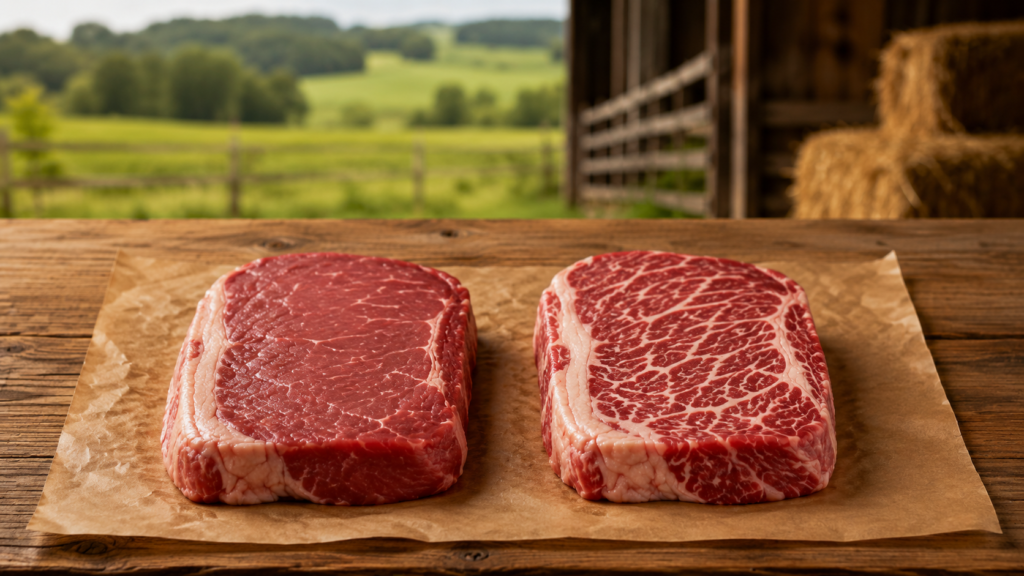
Depending on who’s talking, grass-fed beef is either a health miracle or an overpriced myth. One camp says it will fix your omega-3s and help fight disease. The other says it’s marketing dressed up as nutrition. Both are usually selling you something.
We’d rather just tell you what the research actually shows, including the parts that don’t help anyone’s pitch. Some of it might surprise you.
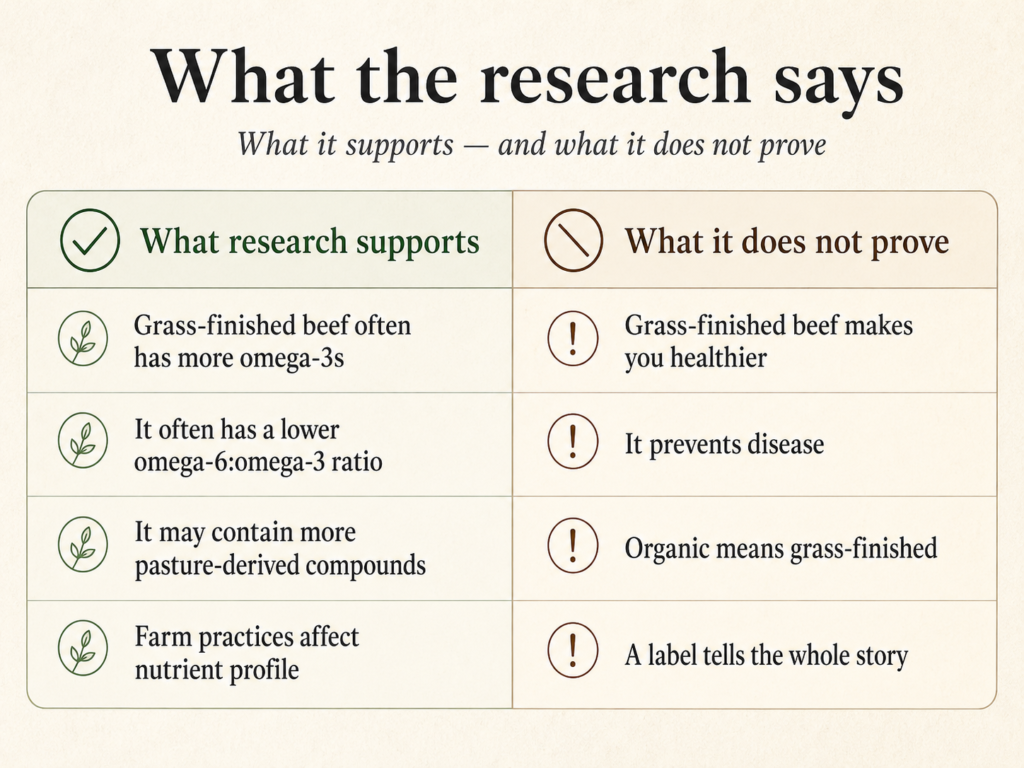
Here’s the short version. Grass-finished beef often does look different on paper. It tends to carry more omega-3 fatty acids, a lower omega-6 to omega-3 ratio, and more pasture-derived compounds. That part is well established. What isn’t established is that eating it will actually make you healthier than grain-finished beef as part of a normal diet. The nutrient differences are real. The proof that those differences change your long-term health just isn’t there yet.
So the honest answer is that the two can be nutritionally different, not that one is automatically better for you. Let’s walk through what that means, starting with the labels, because that’s where most of the confusion lives.
First, what the labels actually mean
The words on the package don’t all describe the same thing, and a couple of them get mixed up constantly.
| Label | What it really means |
|---|---|
| Grass-fed | A claim about what the animal was fed, but standards and verification can vary unless it’s tied to a specific certification. Look for details like “100% grass-fed,” “grass-finished,” or a third-party seal. |
| Grass-finished | The animal was finished on grass or forage rather than a grain-based ration. For nutrition comparisons, this is usually the more meaningful distinction. |
| Grain-finished | The animal may have spent much of its life on pasture, then was finished on a grain-based ration to add weight, tenderness, and marbling. |
| Organic | A production standard covering organic feed, restrictions on antibiotics and added hormones, and pasture requirements. It doesn’t mean the animal was grass-finished. |
For a fuller breakdown of these terms, see our guide to grass-fed, grass-finished, and grain-finished beef.
The one worth slowing down on is grass-finished versus grain-finished, because that’s the distinction that actually drives the nutrition differences. And notice what organic does not tell you, which is a question people ask all the time.
Is organic beef healthier than non-organic beef?
Organic tells you more about how the animal was raised than about what’s in the meat. It means certified organic feed, limits on antibiotics and added hormones, and pasture requirements. Those are real standards. But organic beef can still be grain-finished on organic grain, so the organic label alone doesn’t guarantee the fatty-acid profile people usually associate with grass-finished beef.
There is one place organic shows a measurable edge, and it’s about safety rather than nutrition. A 2021 Johns Hopkins study using national monitoring data found that organic-certified meats were 56 percent less likely to carry multidrug-resistant bacteria than conventionally processed meats. That’s a real food-safety finding. It isn’t proof that eating organic beef improves your long-term health, and it’s about contamination and antibiotic resistance, not nutrients. Good to know, but a different question from whether the meat is “healthier.”
What the research actually shows
Fatty acids
This is the most settled difference. Reviews going back years, including a 2022 review in Food Science of Animal Resources, find that grass-finished beef tends to carry more omega-3s, including the long-chain kind, and a lower omega-6 to omega-3 ratio. A second 2022 review, focused on pasture and organic systems, agreed and made a useful point: it’s the pasture finishing, not the organic label, that drives the change.
Worth keeping honest, though. The same review notes grain-finished beef tends to be higher in monounsaturated fat, which also has heart benefits. Neither profile is simply good or bad. They’re different.
Beyond fat
Newer work suggests the differences go past fat. A 2025 study in npj Science of Food found that 38 percent of the compounds it measured differed between grass-fed and grain-fed beef, with grass-fed higher in antioxidants and in vitamins E and A.
Two caveats keep that number honest. The study compared eight grass-fed samples from three farms against eight grain-fed samples from a single feedlot, which the authors flag as small. And the grass-fed cattle were older at slaughter, which the researchers say could explain some of the vitamin difference on its own. It’s also fair to know that a lot of the most detailed grass-fed research comes from labs focused on regenerative farming, so the boldest numbers are worth reading with that in mind.
The finding that keeps everyone honest
The most useful study for a shopper is also the biggest. The Beef Nutrient Density Project, published in the Journal of Animal Science, tested more than 300 beef samples from farms and stores across North America. On average, grass-fed came out ahead on omega-3s and on minerals like iron, calcium, copper, and selenium, especially when cattle grazed diverse pastures.
But the averages hid a lot. Grass-fed omega-6 to omega-3 ratios ran anywhere from about 0.6 to 11, and some store-bought grass-fed samples looked no better than grain-fed. The researchers’ own conclusion is the quiet headline: simple labels like “grass-fed” and “grain-fed” may not capture what’s actually in the meat, and the field needs clearer definitions and more honest labeling. The finishing system shifts the nutrient profile. The label alone doesn’t guarantee it.
What we actually know about people
Almost all of this measures the meat, not the people eating it, and the human evidence is thin. The most direct piece is a small pilot from Montana State University, ten healthy adults eating steaks from each system, which found a few minor short-term differences and nothing dramatic. An older, small trial found that eating pasture-fed meat did raise omega-3 levels in people’s blood, which at least shows the differences can carry through. Neither study was built to measure long-term health.
What this doesn’t prove
No study here shows grass-finished beef prevents disease or helps you live longer. The differences in the meat are real. The trials you’d need to prove a long-term health payoff, following people for months or years, haven’t been done at that scale. Anyone claiming the science is settled is out ahead of it.
And your overall diet matters far more than this one choice. Grain-finished beef fits fine in a healthy pattern, which the researchers behind this work say themselves.
A note on the research
A lot of the most detailed grass-fed research comes from a small number of labs focused on regenerative farming, and some of it is funded or co-authored by groups that advocate for those systems. That doesn’t make it wrong. The core nutrient differences show up across independent labs, government-funded reviews, and different methods. And the funding runs both ways, since beef-industry programs fund research too. We’ve leaned on findings that show up in more than one place, and flagged where the evidence is still thin.
If it’s not proven healthier, why choose grass-finished?
Plenty of people still do, for reasons that don’t need a health claim.
The nutrient profile is the best-supported one: more omega-3s, a lower omega-6 to omega-3 ratio, more pasture-derived compounds. For some families that’s enough. Taste is its own reason, and it runs both ways. Grass-finished is leaner and more mineral, grain-finished richer and more marbled.
The one I’d point to most is transparency. Grass-finished beef is more often sold straight from the farm that raised it, so you can find out how the animal was raised, ask questions, sometimes even visit. That’s worth more than most labels, and a farm you know tells you more than a sticker does.
Some people also choose pasture-based beef to steer clear of routine antibiotics and added hormones, which are more common in conventional feedlot finishing. Just know that grass-fed alone doesn’t guarantee either. Those are separate claims, and a grain-finishing farm can carry them too, so look for “no added hormones,” “raised without antibiotics,” USDA Organic, or the American Grassfed Association seal. USDA has residue-monitoring programs for drugs in meat, but they’re built mainly around food-safety compliance, not around verifying every animal-raising claim on every package. So “raised without antibiotics” is really a question about how the animal was managed and how well the claim is verified, not just whether the final meat is safe to eat.
One caveat if you’re choosing for the planet: a 2025 study in PNAS found grass-fed beef isn’t lower in carbon than conventional beef, so the environmental case is weaker than it’s often sold as.
Why knowing the farm beats the label
So, is grass-finished beef healthier? Not in any way science has proven. It’s often nutritionally different, which for a lot of people is reason enough, and grain-finished is a perfectly good choice too, especially as part of a varied diet. But whichever way you lean, here’s the part that matters more than the label.
The words on the package promise less than most people assume. Take grass-fed itself: in 2016 the USDA withdrew its official standard for the claim, so today it’s largely defined by each producer. It still means something. What it means just varies.
“Raised without antibiotics” has actually been tested. A 2022 study in Science checked urine from nearly 700 cattle headed for that market and found antibiotics in about 15 percent of them, with at least one positive animal in 42 percent of the feedyards. A 2023 USDA follow-up found much the same. Most producers were playing straight, but a real share weren’t, and nothing on the label would have told you.
“Product of USA” has its own history. For years, beef from animals born, raised, and slaughtered abroad could wear that label as long as it was repackaged here. A 2024 USDA rule, in effect from January 2026, finally requires the animal to be born, raised, slaughtered, and processed in the US. But the claim is voluntary and origin labeling isn’t required, so a package can still tell you very little about where the animal actually lived.
And even a flawless label can only say so much. It can’t tell you how the animals were treated day to day. Welfare comes down to how a specific farm is run, not whether the beef is grass or grain finished, and a feedlot can be well managed while a pasture is neglected. Certifications like Animal Welfare Approved and Certified Humane help, and the ASPCA‘s Shop With Your Heart guide is a good place to start, but the fullest answer comes from the farm. When you can ask the person who raised the animal, you learn things no seal captures.
The label can’t tell you how the land is worked either, and that matters more than it sounds. The nutrients in beef come from what the animal ate, and that traces straight back to the soil and the range of plants growing in it. It’s no accident that the studies above found the biggest nutritional gains where cattle grazed diverse, healthy pasture. Healthy soil grows varied forage, varied forage feeds healthier animals, and that shows up in the meat. A sticker can’t tell you a thing about a farm’s soil. A farmer can walk you through it.
That’s the whole reason Field to Kitchen exists. Labels are shorthand, and shorthand has limits. Buy direct from a farm you can name, question, or visit, and you get the real answers: how the animals live, how the land is tended, how the beef was actually raised. Choose grass-fed and grass-finished, choose grass-fed and grain-finished, choose something else entirely. If you care about any of what we’ve covered here, the better move was never decoding the package. It’s knowing the farm behind it.
Sources
- Nogoy et al., 2022. Fatty Acid Composition of Grain- and Grass-Fed Beef and Their Nutritional Value and Health Implication. Food Science of Animal Resources.
- Nutritional Benefits from Fatty Acids in Organic and Grass-Fed Beef, 2022. Foods.
- Ahsin, van Vliet et al., 2025. Soil and pasture health and beef nutrient density in Southern US grass-finished beef systems. npj Science of Food.
- Varre, van Vliet et al., 2025. Beef Nutrient Density Project: nutritional composition of commercial North American grass- and grain-finishing systems. Journal of Animal Science.
- Spears et al., 2024, and follow-up pilot randomized clinical trial, 2025. Montana State University.
- McAfee et al., 2011. Human intervention trial on pasture-fed red meat and blood omega-3 levels.
- Eshel et al., 2025. US grass-fed beef carbon intensity. PNAS.
- Price, Rogers, and Lo, 2022. Antibiotic residues in cattle marketed as raised without antibiotics. Science.
- US Department of Agriculture, Food Safety and Inspection Service, 2024. Antibiotic residues in cattle reported to be raised without antibiotics. Journal of Agricultural and Food Chemistry.
- Innes et al., 2021. Contamination of retail meats with multidrug-resistant organisms in organic and conventional production (NARMS, 2012 to 2017). Environmental Health Perspectives, Johns Hopkins Bloomberg School of Public Health.
- USDA Agricultural Marketing Service, 2016. Withdrawal of the grass-fed marketing claim standard.
- USDA Food Safety and Inspection Service, 2024. Voluntary labeling of FSIS-regulated products with US-origin claims (“Product of USA” final rule), effective January 2026.