
Grass-Fed vs. Grass-Finished vs. Grain-Finished Beef: What the Difference Actually Means
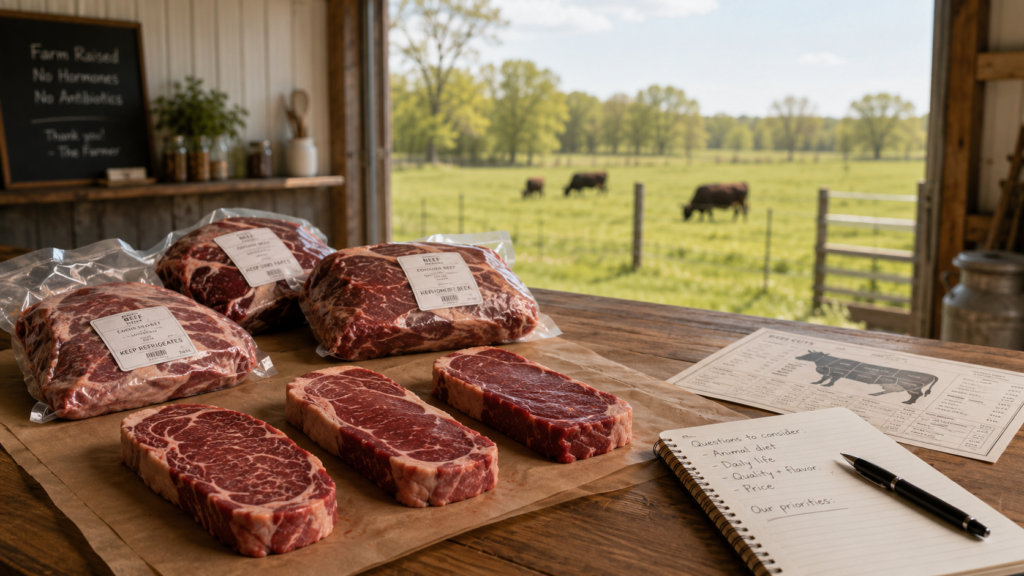
Few beef labels create more confusion than grass-fed, grass-finished, and grain-finished.
Part of the problem is that they sound self-explanatory until you try to compare farms. One farm says “grass-fed,” another says “grass-finished,” another says “pasture-raised and grain-finished” — and suddenly what seemed like a simple distinction starts to feel slippery.
That confusion matters more when you are buying directly from a farm. These labels shape what many people expect in terms of flavor, marbling, and overall eating experience. And when you are committing to a quarter or half cow upfront, understanding what you are actually buying makes a real difference.
The terms are not meaningless. They just need context.
The thing most people get wrong
When buyers hear “grass-fed,” most imagine cattle that spent their entire lives on open pasture, eating nothing but grass from birth to harvest. And when they hear “grain-finished,” they picture feedlot cattle that never saw a field.
Neither picture is quite right.
In practice, most beef cattle — whether they end up grass-finished or grain-finished — spend the early part of their lives nursing and grazing on pasture. The real difference shows up in the finishing phase: the final months before harvest when cattle reach market weight.
Grass-finished cattle stay on forage through that entire period.
Grain-finished cattle are moved onto a higher-energy ration — typically grain plus roughage — for the final stretch, usually somewhere between four and six months.
That is the actual distinction. Not “pasture cow versus feedlot cow from birth.” More like: forage all the way through, or forage followed by a grain-finishing period.
Why labels alone are not enough
Labels are useful, but they are not the whole story.
Two farms can both use similar language and still produce very different beef depending on genetics, forage quality, climate, finishing skill, and how transparent they are about their system. The label helps start the conversation. It should not end it.
This is especially true for grass-finished beef, where the quality of the result depends heavily on how well the farm’s cattle, land, and management all fit together. A label tells you something about intent. How clearly a farm explains that intent tells you a lot more.
What “grass-fed” actually tells you
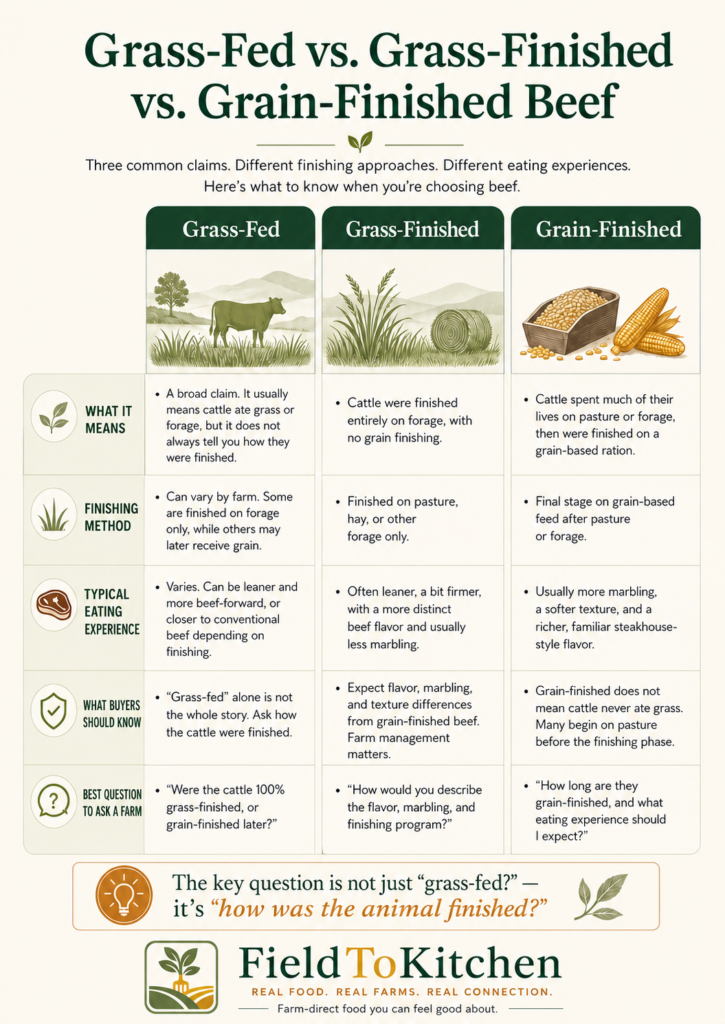
Grass-fed is a broad starting claim. It generally means cattle were raised on grass and forage rather than a primarily grain-based diet but it does not automatically mean the animal was finished on grass.
A buyer hears “grass-fed” and may imagine a fully pasture-based system from weaning to harvest. Sometimes that is exactly what a farm means. Sometimes it is not. The label can be used to describe systems that still involve grain at the end.
One more term worth clarifying here: “pasture-raised” tells you something about how cattle lived, but it does not automatically tell you how they were finished. A farm can raise cattle on pasture and still grain-finish them later. Pasture-raised and grass-finished are not the same thing.
Grass-fed is a starting point, not the full picture.
What “grass-finished” actually tells you
Grass-finished is the more specific claim. It means the animal was brought all the way to harvest weight on grass and forage, with no grain-finishing period.
This is usually what buyers are trying to confirm when they ask whether beef is “really grass-fed.”
Finishing cattle on forage alone is not as simple as it sounds. It depends heavily on forage quality, climate, season length, breed, and overall management. Farms that do it well usually have a clear explanation for why their system works and the cattle they raise are a big part of that story.
Why breed matters more than most buyers realize
Here is something worth knowing that most beef label conversations skip entirely: the same finishing system can produce very different results depending on the cattle.
Not every breed finishes well on grass. Cattle that are large-framed and lean by nature need more energy to reach a good degree of finish which means forage alone can leave them underdeveloped at harvest. The farms that do grass-finishing well tend to raise cattle that are naturally suited to it: moderate-framed, efficient on forage, and able to develop good marbling without grain.
This is why certain breeds come up repeatedly in grass-finishing conversations. A few worth knowing:
Red Devon. One of the oldest British beef breeds and a longtime favorite among grass-finishing operations. Known for thriving on rough forage, finishing efficiently on pasture, and producing well-marbled beef without grain. When a farm lists Red Devon, it can be a signal that the operation is intentionally oriented around a forage-based system rather than treating grass-finishing as an afterthought.
Black Angus. The most common beef breed in the United States. Performs well in both grass-finished and grain-finished systems. Good marbling potential and consistent eating quality. A reliable choice across a wide range of farm types.
Hereford. A British breed with a long history in pasture-based systems. Known for docility, foraging ability, and solid carcass quality. Often found on traditional family farms.
Highland cattle. A hardy heritage breed originally from Scotland. Well-adapted to rough terrain and cold climates. Slower-growing, leaner, and often described as having a distinctive flavor. Less common but worth knowing if you see it listed.
Wagyu and Wagyu crosses. Known for exceptional marbling potential. Often grain-finished to develop the extreme intramuscular fat the breed is capable of. Grass-finished Wagyu exists but is less common and produces a different result than grain-finished.
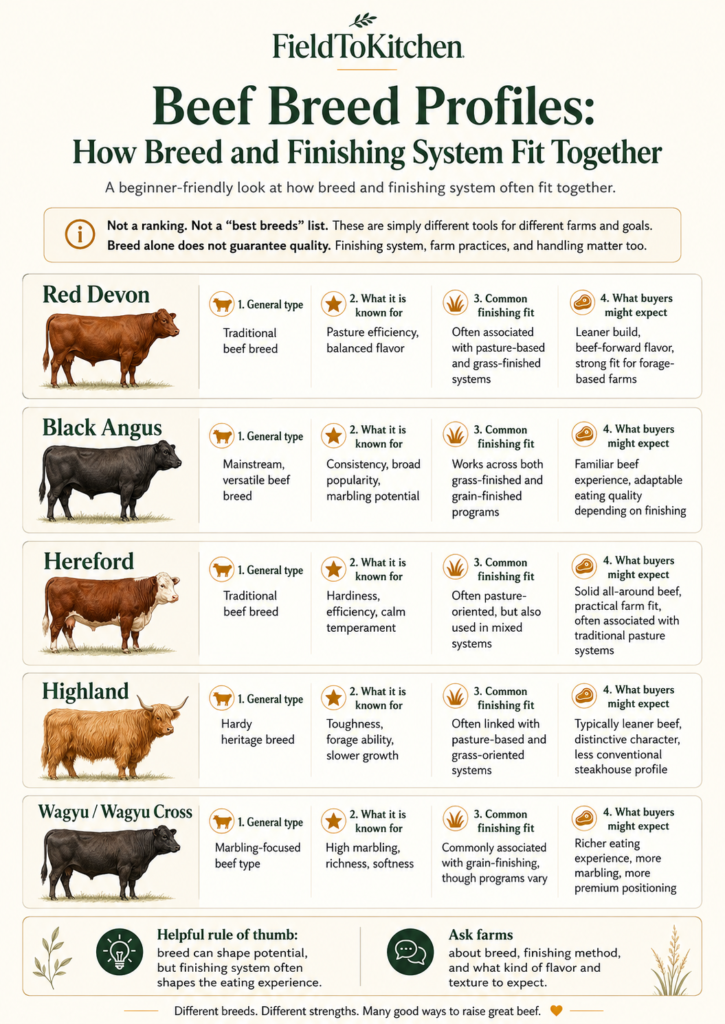
When a farm lists its breed on FieldToKitchen, it is worth paying attention to. That’s not because one breed is universally better, but because breed and finishing system should fit each other. A farm raising Red Devon on rotational pasture is telling you something coherent. A farm raising large-framed cattle and claiming grass-finished may be worth a follow-up question.
What “grain-finished” actually tells you
Grain-finished does not mean the cattle never saw a pasture. It means the finishing phase — the final stretch before harvest — involved a grain-based ration rather than forage alone.
The reason farms finish on grain is straightforward: it accelerates weight gain, supports higher marbling levels, and allows more predictable harvest timing. Grain-finished cattle typically reach market weight faster and at heavier weights than grass-finished cattle.
For many farms and buyers, that is a deliberate choice rather than a compromise. Grain-finished beef is not lower-quality beef. It is a different kind of beef, optimized for a different eating experience.
How the eating experience actually differs
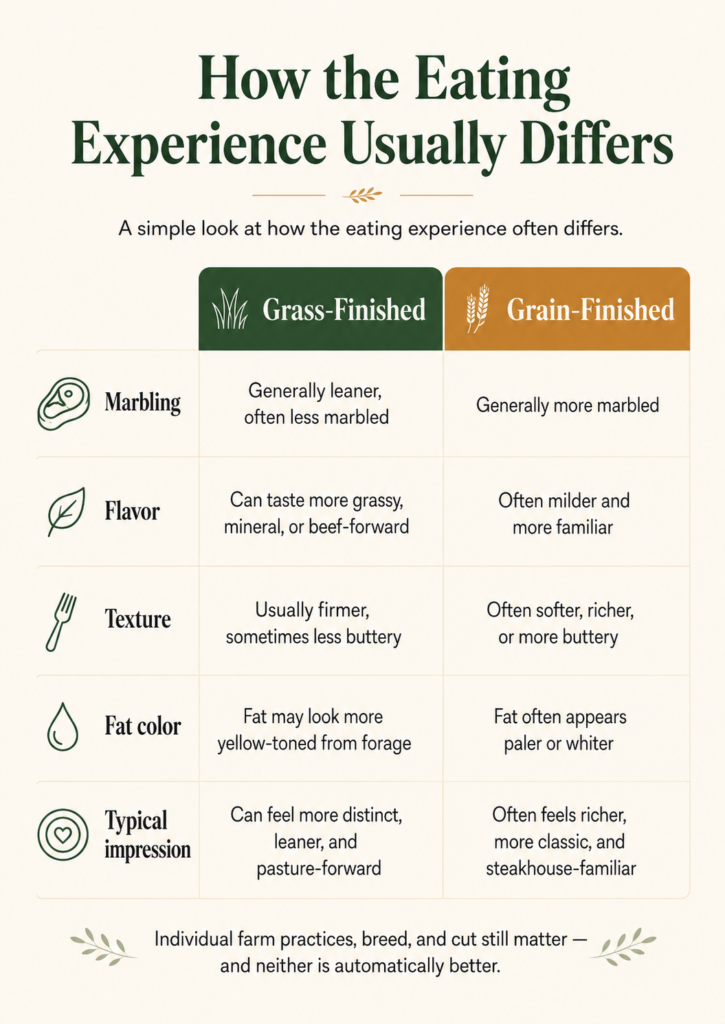
This is where buyers want a simple answer, and the honest one is: it depends, but there are real tendencies.
Grass-finished beef is generally leaner, with less marbling and a somewhat more pronounced — sometimes described as grassy or mineral — flavor profile. The texture is often firmer. Fat tends to be more yellow in color, which reflects the beta-carotene in forage.
Grain-finished beef tends to develop higher marbling levels, a milder and more familiar flavor profile, and the kind of rich, buttery texture many people associate with a classic steakhouse steak. The higher-energy finishing ration and heavier market weights both contribute to that.
Neither is objectively better. They are different, and preference is genuinely personal. Some people love the leanness and distinctiveness of grass-finished beef. Others prefer the richer marbling and milder flavor of grain-finished. Many people enjoy both depending on the cut and how they are cooking.
In practical terms, buyers looking for richer marbling and a more classic steakhouse feel often prefer grain-finished beef, while buyers looking for a leaner, more pasture-driven profile may prefer grass-finished beef.
What to ask a farm before buying
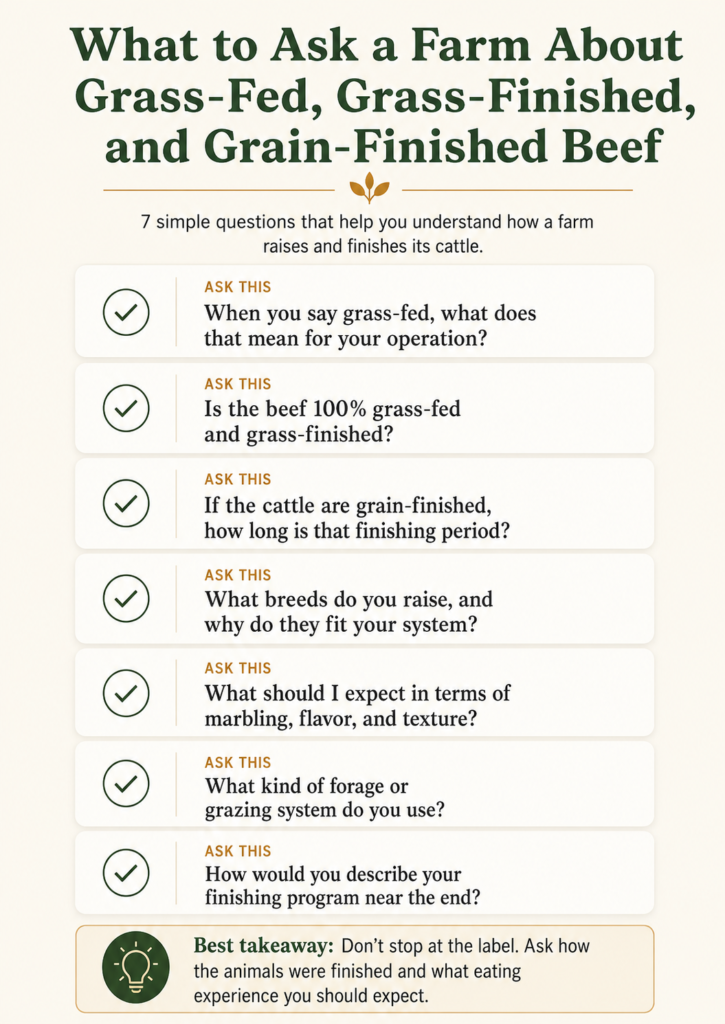
If you are buying direct, these labels should lead to better questions rather than stronger assumptions.
Worth asking:
- When you say grass-fed, what does that mean in practice for your operation?
- Is the beef 100% grass-fed and grass-finished, or is there any grain involved at any stage after weaning?
- If the cattle are grain-finished, how long is that finishing period and what does the ration look like?
- What kind of forage or grazing system do you use?
- What should I expect in terms of marbling, flavor, and texture?
- What breeds do you raise, and why do they fit your system?
- How do you describe the eating experience to first-time buyers?
A good farm should welcome these questions. How clearly they answer them tells you a lot about how transparent they are about what they raise and how.
The bottom line
Grass-fed, grass-finished, and grain-finished are not interchangeable — but they are also not as far apart as the labels might suggest.
Most beef cattle spend the majority of their lives on pasture regardless of how they are finished. The meaningful difference is what happens at the end: forage all the way through, or a grain-finishing period before harvest.
Grass-fed is the broadest claim. Grass-finished is the more specific one. Grain-finished describes a finishing choice, not a poor-quality shortcut. And breed matters more than the label alone — because a finishing system is only as good as the cattle running through it.
Understanding what each term actually means, and asking farms to explain what they mean by it, gets you a lot further than treating any single label as a guarantee.
FAQ
Is grass-fed the same as grass-finished?
Not always. Grass-fed is a broad claim that means cattle ate grass or forage rather than a primarily grain-based diet, but it does not automatically mean the animal was finished on grass. Grass-finished is the more specific term. It means the animal was brought all the way to harvest weight on forage, with no grain finishing period. If this distinction matters to you, ask the farm directly.
Can beef be grass-fed and grain-finished?
Yes. This is actually common. Many farms raise cattle on pasture for most of their lives and then move them onto a grain-based ration for the finishing phase. That beef may accurately be described as grass-fed while still being grain-finished. When comparing farms, it is worth asking specifically whether the cattle are grass-finished, not just grass-fed.
Does grain-finished mean lower quality?
No. Grain-finished beef is not lower-quality beef. It is a different kind of beef. Grain-finishing typically produces higher marbling levels, a milder flavor, and the richer, more familiar texture many people associate with a steakhouse steak. Whether that appeals to you depends on personal preference, not on a quality hierarchy between the two systems.
Why do some breeds do better on grass?
Cattle that finish well on forage tend to be moderate-framed, efficient on grass, and able to develop good marbling without the higher-energy boost of grain. Large-framed, lean-natured cattle often need more energy to reach a good degree of finish, which makes forage alone harder to work with. This is why certain British breeds — like Red Devon and Hereford — come up frequently in grass-finishing conversations. They were developed for exactly this kind of system.