
How Much Freezer Space Do You Need for a Beef Share?
You’ve done the research. You found a farm you trust, you know what share size you want, and the idea of stocking your freezer with a variety of farm-direct beef feels like one of the better decisions you’ve made in a while.
Then it hits you.
Where is all of this actually going to go?
It’s one of those questions that catches a surprising number of first-time buyers off guard, sometimes not until they’re standing at pickup with 200 pounds of vacuum-sealed beef and a freezer at home that’s already half full of frozen peas and things they can’t quite identify.
The good news is that freezer planning is simpler than it sounds. You don’t need to obsess over exact cubic inches or buy a new freezer before you’ve even placed a deposit. You just need a realistic sense of what fits where and a little bit of a plan before the beef arrives.
The numbers you actually need
Here are the estimates worth starting with:
- An eighth cow: roughly 1.5 to 2 cubic feet
- A quarter cow: roughly 4 to 5 cubic feet
- A half cow: roughly 8 to 10 cubic feet
- A whole cow: roughly 16 to 20 cubic feet
These are planning numbers, not guarantees. The actual amount varies based on share size, how the beef is cut and packaged, and whether you asked for bone-in cuts, thick steaks, or larger roasts. But as a starting point for figuring out whether your freezer situation is realistic, these ranges hold up.
One thing people consistently underestimate: how much space they actually have available. A freezer listed as 8 cubic feet isn’t 8 cubic feet of usable space if half of it is already occupied by frozen peas, last year’s chili, and things you’ve been meaning to use for months. The usable number is what matters.
What actually affects how much space you need
Share size is the biggest factor, but not the only one.
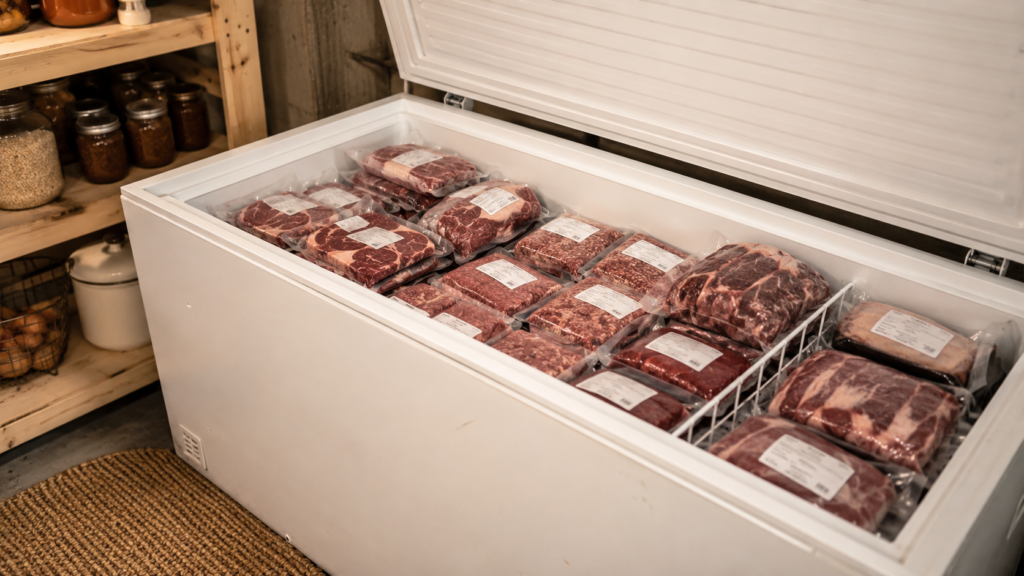
How the beef is packaged makes a real difference. Vacuum-sealed flat packages stack neatly and efficiently. Bulky paper-wrapped cuts or oddly shaped packages of the same total weight can feel like twice the volume. If you have a choice, vacuum-sealed is almost always easier to organize.
Bone-in cuts take up more room than boneless. They’re harder to stack and less uniform in shape. If you go heavy on bone-in short ribs or bone-in chuck, expect things to feel a little more chaotic in the freezer.
Ground beef is usually your best friend. Ground beef that comes in flat one-pound vacuum-sealed packages stacks like bricks. A share with a lot of ground beef often organizes more cleanly than one loaded with irregular cuts.
Your real usable space is what you’re working with, not the number on the spec sheet. Baskets, shelves, existing food, and the general accumulated mystery of a household freezer all eat into that number. Before you commit to a share size, do a quick audit of what’s actually in there and whether you’re willing to clear it out.
Chest freezer or upright freezer?
Both work. The choice mostly comes down to how you like to manage food, how much space you have, and honestly, what kind of person you are about organization.
Chest freezers are more energy efficient. When you open the lid, the cold air stays put rather than spilling out like it does with an upright. They also tend to hold temperature longer during a power outage, which matters more when you have a half cow in there. And for pure storage capacity per dollar, chest freezers usually win.
The downside is well-documented by anyone who’s ever owned one: things disappear to the bottom. What starts as a well-organized freezer gradually becomes a mystery archive of items you forgot you had. The solution isn’t to avoid chest freezers. It’s to build in some structure from the start. Milk crates, freezer baskets, dividers, or even labeled reusable bags grouped by cut type all work well. Some chest freezers come with built-in dividers or sliding basket systems that make organization much more manageable. If you go the chest freezer route, plan your organization system before you load it, not after.
One practical note: if you’re on the shorter side, reaching the bottom of a deep chest freezer while hauling out a heavy roast is genuinely annoying. Worth considering before you buy.
Upright freezers are easier to use day to day. Steaks on one shelf, roasts on another, ground beef in a drawer, bones in the back. You can actually see what you have without excavating. The tradeoff is that they’re usually less energy efficient, and things can slide or fall out when you open the door if packages aren’t stacked carefully. They also tend to have more wear on the door seals over time.
One option worth knowing about: some people who buy beef shares regularly run two or three smaller chest freezers instead of one large unit. It sounds like more effort but it actually solves the organization problem. One freezer for beef, one for everything else, and you can unplug one as it empties out. More flexible than a single large unit and easier to fit into a garage or basement.
The honest answer is that neither is universally better. An upright works better for people who want visibility and easy access. A chest freezer works better for people who want capacity, efficiency, and are willing to build in some organization from the start. The best freezer is the one that fits your space, your budget, and your actual habits, not the one that sounds most impressive on paper.
A quarter, a half, or a whole: what it actually feels like
A quarter cow is manageable for most households. If you have a chest freezer in the garage or an upright with a couple of empty shelves, a quarter usually fits without much drama. It’s also the reason first-time buyers often start here, not just because of cost, but because the logistics are forgiving.
A half cow is a different commitment. It usually needs its own dedicated freezer or a chest freezer with real room to spare. If you’re already squeezing frozen pizza boxes next to meal prep containers and berries, a half cow is going to feel bigger than it sounds.
A whole cow is a dedicated freezer or split purchase situation. It’s absolutely doable, but it’s not something you casually tuck into a corner. Most households that buy whole cows either have a serious chest freezer setup or split the purchase with another family, which is often the better idea anyway.
It’s not just about space
Freezer capacity is the obvious question. But there are a few others worth thinking through before you commit.
Will you actually cook the variety of cuts? A beef share isn’t a box of steaks. You’re getting ground beef, roasts, stew meat, short ribs, brisket, bones, and possibly organ meats depending on what you requested. That variety is part of the value, but it also means your freezer becomes a mild meal-planning commitment. If you realistically only cook ground beef and the occasional ribeye, a share might not be the best fit, or a smaller one might serve you better.
Do you have any system for organizing it? Even a perfectly sized freezer becomes frustrating if everything gets stacked in randomly at pickup and stays that way. A simple approach works well: steaks together, roasts together, ground beef stacked flat, older packages toward the front. Labels help more than you’d think.
Would splitting make more sense? Sometimes the right answer to the freezer question isn’t “I need a bigger freezer” but “I should split this with someone.” A half or whole cow split between two households often makes more sense than one household trying to manage more beef than they can realistically use well.
Signs a beef share might be too much for your freezer
A beef share is worth pushing off if your freezer is already stuffed and you have no plan to clear it, you’re hoping to “make it work somehow” without actually thinking it through, or you don’t really want a mix of cuts and are mainly hoping for a box of steaks.
None of that means buying direct is the wrong choice. It might just mean starting with a smaller share, a variety box, or a split purchase rather than going straight to a half cow.
What to ask a farm before you commit
A good farm will have answered these questions many times before. If they can’t answer them clearly, that tells you something too.
- How much packaged beef does this share typically yield?
- What freezer size do you usually recommend?
- Is the beef vacuum-sealed or paper-wrapped?
- How is the ground beef packaged?
- Can you give me a sense of what a typical quarter or half looks like at pickup?
- Do buyers often split this share size with another household?
What fits your freezer and your life
A quarter cow usually fits more easily than people expect. A half cow usually needs a real plan. A whole cow usually deserves dedicated storage or a split purchase.
The goal isn’t to maximize the amount of beef you can fit into a freezer. It’s to buy a share size that works with your space, your cooking habits, and your household, one that still feels like a good decision six months later when you’re pulling things out and actually using them.
Freezer planning isn’t the most exciting part of buying direct. But it’s one of the easiest ways to make sure the experience stays practical rather than turning into a project you regret.